
Nylon chemical compatibility chart is the quickest way to compare PA6, PA66, and PA12 against fuels, oils, water, acids, alkalis, and common solvents. The best choice usually depends on exposure, temperature, and load, not just the resin name.
This page is a quick-reference support guide, not a replacement for full testing. If you need a deeper breakdown by chemical class or failure mechanism, see our nylon chemical resistance guide. If moisture or outdoor weathering will also affect the part, review nylon moisture absorption und UV stabilized nylon outdoor weathering before final material selection.
For product engineers, sourcing teams, and QA
Select the Nylon Grade by Exposure, Not by Habit
Use PA12 when fluid exposure and low moisture uptake matter most. Use PA66 when stiffness and heat dominate. Use PA6 when the application is moderate and cost matters.
- Exposure: fluids, humidity, UV, and cleaning chemicals
- Load: static, dynamic, or sealing contact
- Process: molding, machining, or extrusion
Auf einen Blick
| Chemical / Environment | PA6 | PA66 | PA12 | Best First Check |
|---|---|---|---|---|
| Water / high humidity | Messe | Messe | Gut | PA12 where low moisture uptake matters. |
| Gasoline / diesel / oils | Gut | Gut | Ausgezeichnet | PA12 for fuel and fluid handling. |
| Weak alkalis | Messe | Messe | Gut | Check temperature and stress first. |
| Strong alkalis | Schlecht | Schlecht | Messe | Nylon is usually not the best long-term choice. |
| Weak acids | Messe | Messe | Befriedigend bis gut | Short exposure may be acceptable. |
| Strong mineral acids | Schlecht | Schlecht | Schlecht | Consider other engineering plastics. |
| Alkohole | Gut | Gut | Gut | Nylons often tolerate alcohols well. |
| Hydrocarbon solvents | Gut | Gut | Ausgezeichnet | PA12 usually gives the best stability. |
| Chlorinated / aggressive solvents | Schlecht | Schlecht | Messe | Always verify with test data first. |
| Outdoor weathering + fluid exposure | Messe | Messe | Gut | UV package, color, and wall thickness matter. |
How to read the chart: “Excellent” means nylon is often suitable with normal design controls. “Good” means the grade is commonly used but still needs confirmation of temperature and time. “Fair” means service may be possible in controlled conditions but should not be assumed safe by default. “Poor” means nylon is usually the wrong first choice unless exposure is brief or non-critical.
Which Grade Usually Comes First
PA12 usually gives the broadest real-world compatibility inside the nylon family, especially where fuels, oils, and low moisture uptake matter. That is why PA12 often appears in fluid handling, tubing, and outdoor assemblies.
PA66 is commonly selected when heat resistance, stiffness, and creep performance matter more than moisture resistance. It can still perform well in oils and fuels, but its higher moisture uptake can shift dimensions over time.
PA6 is often the most cost-effective engineering nylon for general use, but it is also the grade where designers most often underestimate moisture effects and chemical sensitivity under long exposure.
Why Nylon Compatibility Changes So Much
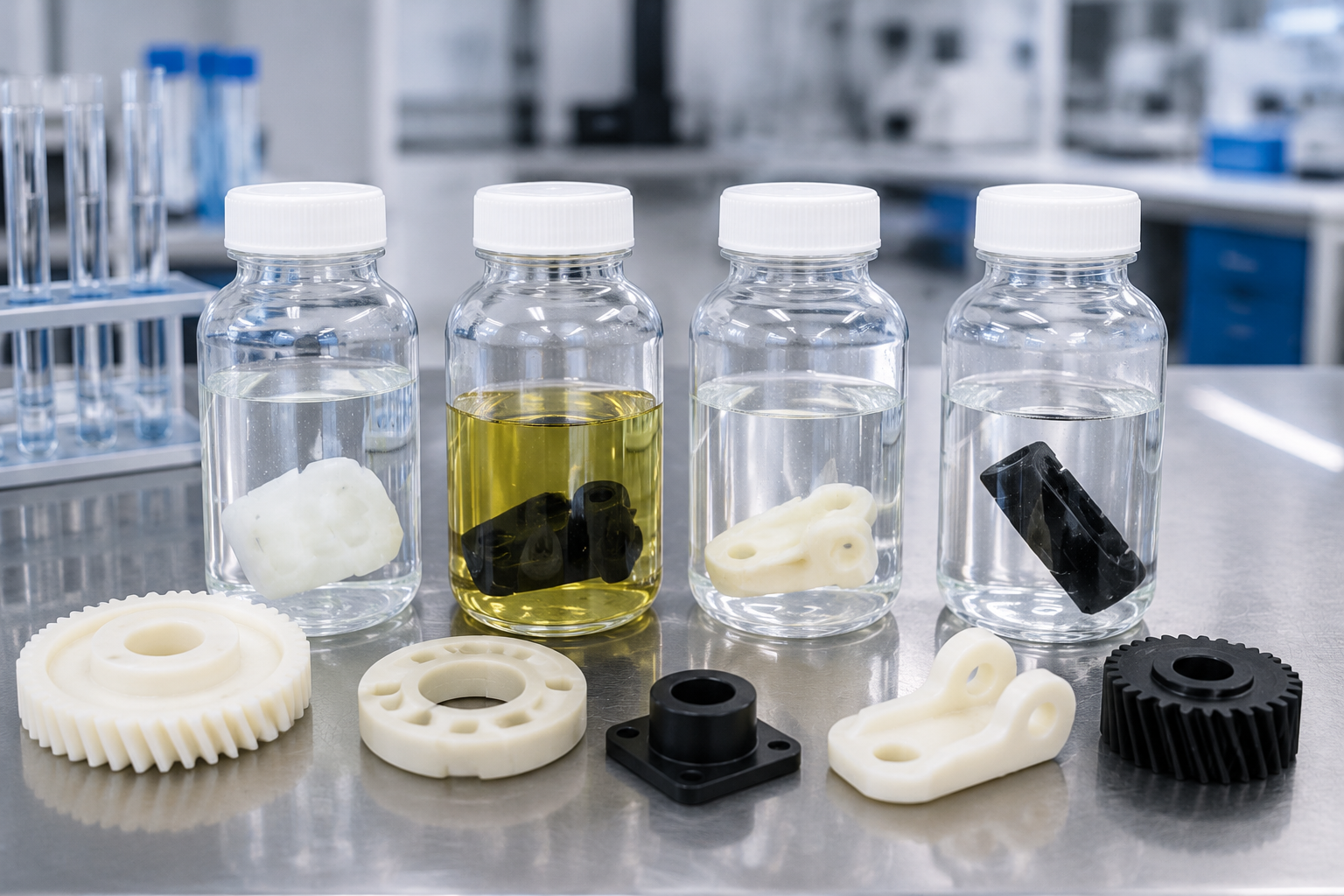
The same nylon grade can behave very differently depending on concentration, temperature, exposure time, mechanical stress, moisture history, and fillers or additives. That is why a simple “nylon is resistant” statement is unreliable.
- Concentration: diluted cleaners and concentrated acids are not the same case.
- Temperature: heat accelerates swelling, hydrolysis, and stress cracking.
- Exposure time: splash contact is not the same as immersion.
- Mechanical stress: loaded parts can fail earlier than test coupons.
- Moisture history: conditioned nylon may react differently than dry-as-molded nylon.
- Additives: glass fiber, UV stabilizers, and impact modifiers can shift performance.
When This Chart Is Enough, and When It Is Not
This chart is useful for early screening, quick grade comparison, shortlist creation, and routing users into the correct deeper technical page. It is not enough for regulated fluid-contact applications, hot chemical immersion, long-term outdoor chemical exposure, or mixed chemical plus thermal cycling.
For broader cross-material comparison, use our engineering plastics compatibility chart. For nylon-specific detail by fluid family and failure mechanism, return to the full nylon chemical resistance guide.
Quick Shortlist by Application
| If your application needs… | Usually check first | Warum |
|---|---|---|
| Fuel and oil resistance with low moisture uptake | PA12 | Best balance of fluid resistance and dimensional stability. |
| Higher heat and stiffness for structural parts | PA66 | Often better when thermal and structural load dominate. |
| Lower-cost general engineering nylon | PA6 | Often the most economical starting point. |
| Outdoor service with sunlight and moisture cycling | UV-stabilized PA12 or stabilized PA66 | Environmental durability depends on chemistry and weathering package. |
| Aggressive solvents or strong mineral acids | Do not assume nylon | Another engineering plastic may be a better first candidate. |
Weiterführende Lektüre
- Nylon 6 im Vergleich zu Nylon 66
- PA6 vs PA12
- Nylon Chemical Resistance Guide
- UV Stabilized Nylon Outdoor Weathering
FAQ
Is nylon chemically resistant?
Yes, but only in a conditional sense. Nylon can perform well in oils, fuels, and some alcohols, but resistance changes significantly with grade, temperature, concentration, and exposure time.
Which nylon grade has the best chemical compatibility?
PA12 usually offers the best overall compatibility when fuels, moisture control, and dimensional stability matter. PA66 and PA6 can still be better choices when cost, heat resistance, or stiffness dominate the design brief.
Is PA66 more chemical resistant than PA6?
Not always. PA66 often wins on heat and stiffness, but PA6 and PA66 can both be outperformed by PA12 in moisture-sensitive and fuel-related environments. Use the specific fluid and temperature as the deciding factor.
Does nylon resist acids and bases?
Nylon usually performs poorly in strong mineral acids and strong alkalis. Weak or short-term exposure may be manageable in some cases, but it should not be assumed safe without confirmation.
What is the difference between nylon chemical resistance and nylon chemical compatibility?
In practice they are often used interchangeably, but “compatibility” usually implies a more application-focused judgment that includes exposure time, stress, and dimensional stability, not just lab resistance data.
Need Help Choosing the Right Nylon Grade?
If your part will see fuels, cleaners, solvents, humidity, or outdoor cycling, material choice should be made with both environment and manufacturing process in mind. We can help compare PA6, PA66, PA12, and reinforced or stabilized variants for molding, extrusion, machining, or additive manufacturing.
If you are moving from material screening to production, review our nylon engineering plastics page for grade options, Dienstleistungen im Bereich Nylon-Spritzguss for molded parts, nylon CNC machining services for machined parts, and nylon 3D printing service for prototypes or low-volume functional parts.
Need a nylon compatibility review?
Send fluid, temperature, load, and geometry details. We can help shortlist PA6, PA66, or PA12 before tooling or qualification starts.

