Custom plastic bushings are one of those parts where the failure mode tells you more than the drawing. If the shaft is rough, the speed is high, or lubrication is inconsistent, the wrong resin will show it quickly through noise, wear or heat buildup.
That is why a good manufacturer does not start with price. It starts with shaft finish, load, duty cycle, temperature, lubrication and whether the bushing needs to survive as a wear surface or just as a locating element.
For motion, automation and equipment maintenance teams
Select the Bushing as a Tribological System
The bushing, shaft, load, speed, temperature and lubrication method work together. Material properties alone cannot predict wear life.
- Load and speed: use PV and duty cycle as screening inputs
- Fit: account for press fit, thermal expansion and moisture where relevant
- Process: machine custom and lower-volume parts; mold stable repeat programs
Auf einen Blick
| Material | Typical Strength | Selection Caution |
|---|---|---|
| Nylon | Tough, wear-resistant and economical | Moisture can affect dimensions |
| POM / Acetal | Stable, low friction and easy to machine | Check temperature and chemical exposure |
| UHMW-PE | Low friction and strong impact behavior | Lower stiffness limits close fits |
| PTFE | Very low friction and broad chemical resistance | Creep and load capability need review |
| PEEK | High temperature and demanding service | Use only when performance justifies cost |
Bore Fit, Wall Thickness and Wear Surface Design
A bushing bore can change after press fitting because the housing compresses the outside diameter. The design must connect housing bore, interference, wall thickness and final running clearance rather than treating each dimension independently.
Flanges, lubrication grooves, split lines and retention features can improve assembly, but they also change stress and machining cost. The shaft finish and hardness are part of the wear system and should be included in the supplier review.
RFQ Checklist for Custom Plastic Bushings
- Provide load and motion: radial load, speed, stroke, oscillation and duty cycle guide material selection.
- State shaft details: diameter, material, hardness, finish and tolerance affect wear and clearance.
- Define installation: housing bore, press fit, adhesive or mechanical retention changes the final bore.
- List the environment: heat, moisture, chemicals, dust, washdown and food contact all matter.
- Share annual demand: quantity determines whether turning, milling or molding is economical.
Application and Manufacturing Matrix
| Anwendung | Recommended Direction | Important RFQ Detail |
|---|---|---|
| Conveyor pivot or roller | Nylon, POM or UHMW depending on load and speed | Shaft finish, contamination and duty cycle |
| Chemical equipment | PTFE, PEEK or compatible engineering plastic | Media, temperature and creep load |
| Food or packaging machine | Qualified low-friction grade where required | Cleaning method and documentation |
| Precision linkage | POM, PET or stable wear grade | Running clearance and alignment |
Common Project Risks and Practical Fixes
| Risiko | Warum das so ist | Praktische Lösung |
|---|---|---|
| Bushing seizes after installation | Press fit closes the bore or heat reduces clearance | Calculate installed clearance and operating temperature |
| Wear is faster than expected | PV, shaft finish or contamination was ignored | Review the complete sliding pair |
| Bore drifts with humidity | Moisture-sensitive nylon was selected | Use conditioning targets or a more stable material |
| Flange cracks during assembly | Interference, wall or corner geometry is unsuitable | Adjust fit and add practical radii |
Machined vs Molded Plastic Bushings
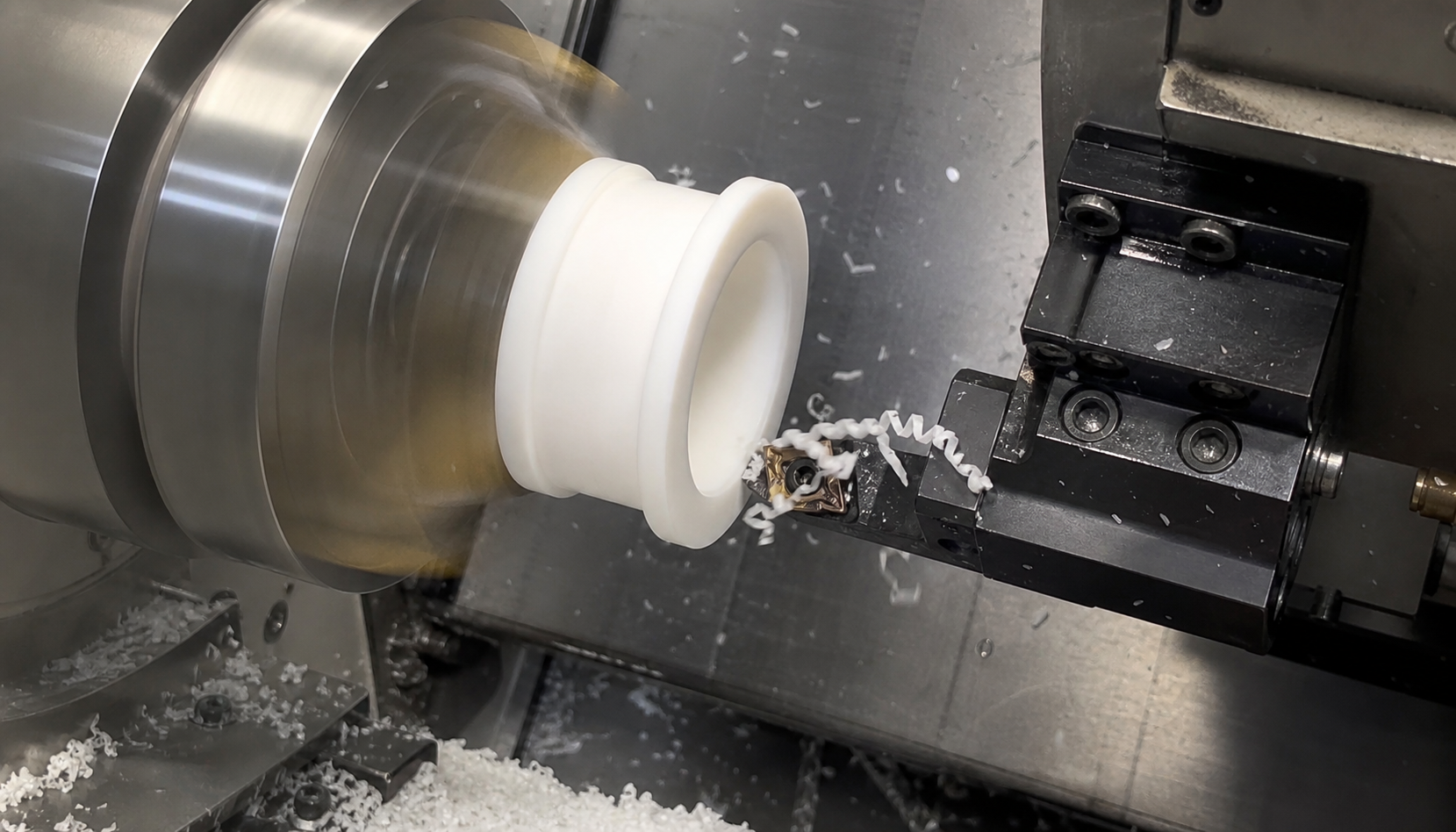
Machined bushings avoid tooling, support many materials and allow fast changes to bore, flange and groove geometry. They are the normal choice for replacement parts, development builds and recurring moderate volumes.
Molded bushings can lower unit cost and integrate retention features at high volume, but shrinkage, weld lines and tool tolerance must be validated. The break-even point depends on size, material, cavity count and annual demand.
Need material and installed-fit review?
Send the bushing drawing, shaft and housing dimensions, load, speed, environment and quantity. We can review the wear material and final running clearance before quoting.
Warum Nylon-Kunststoff?
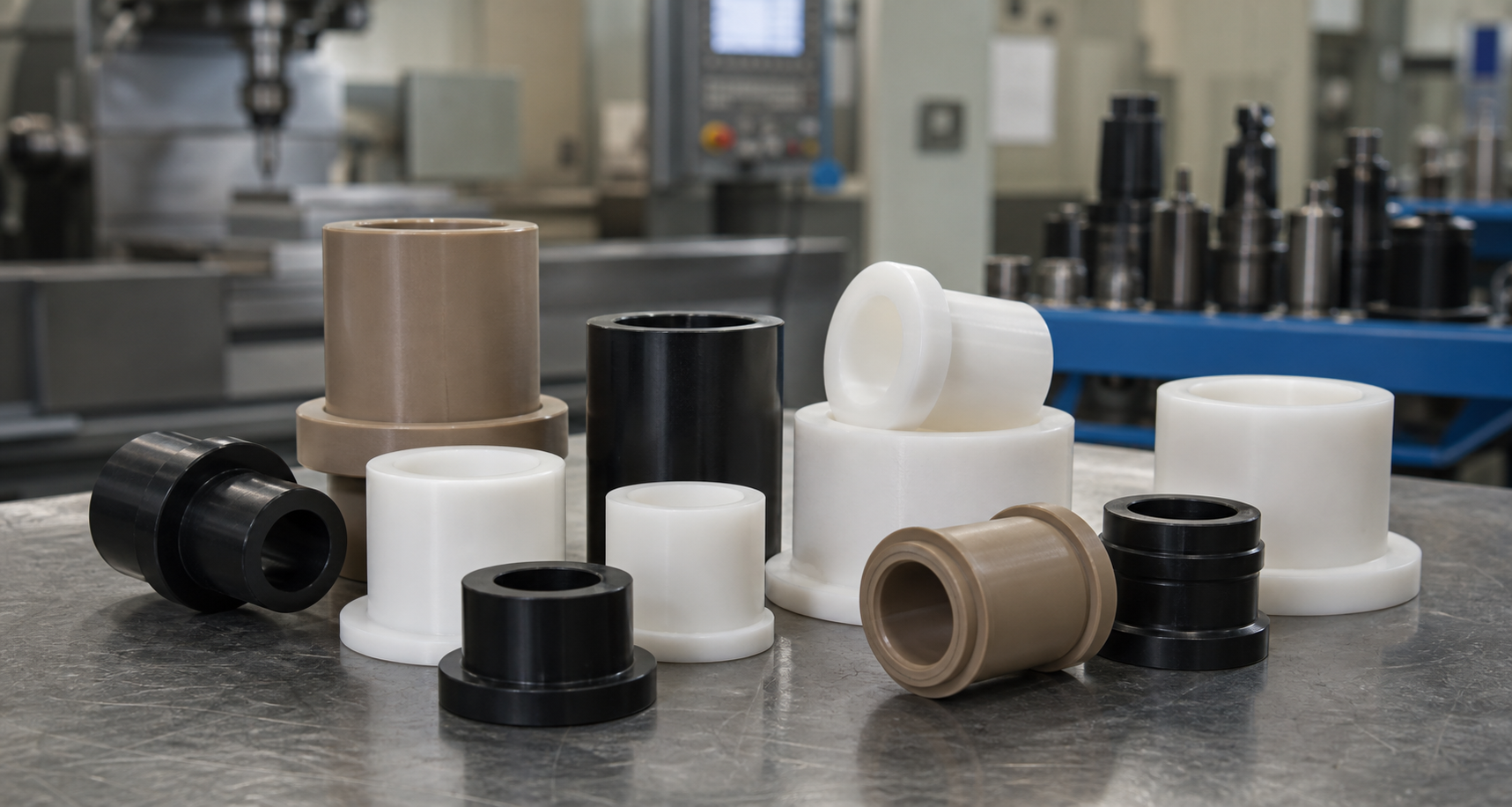
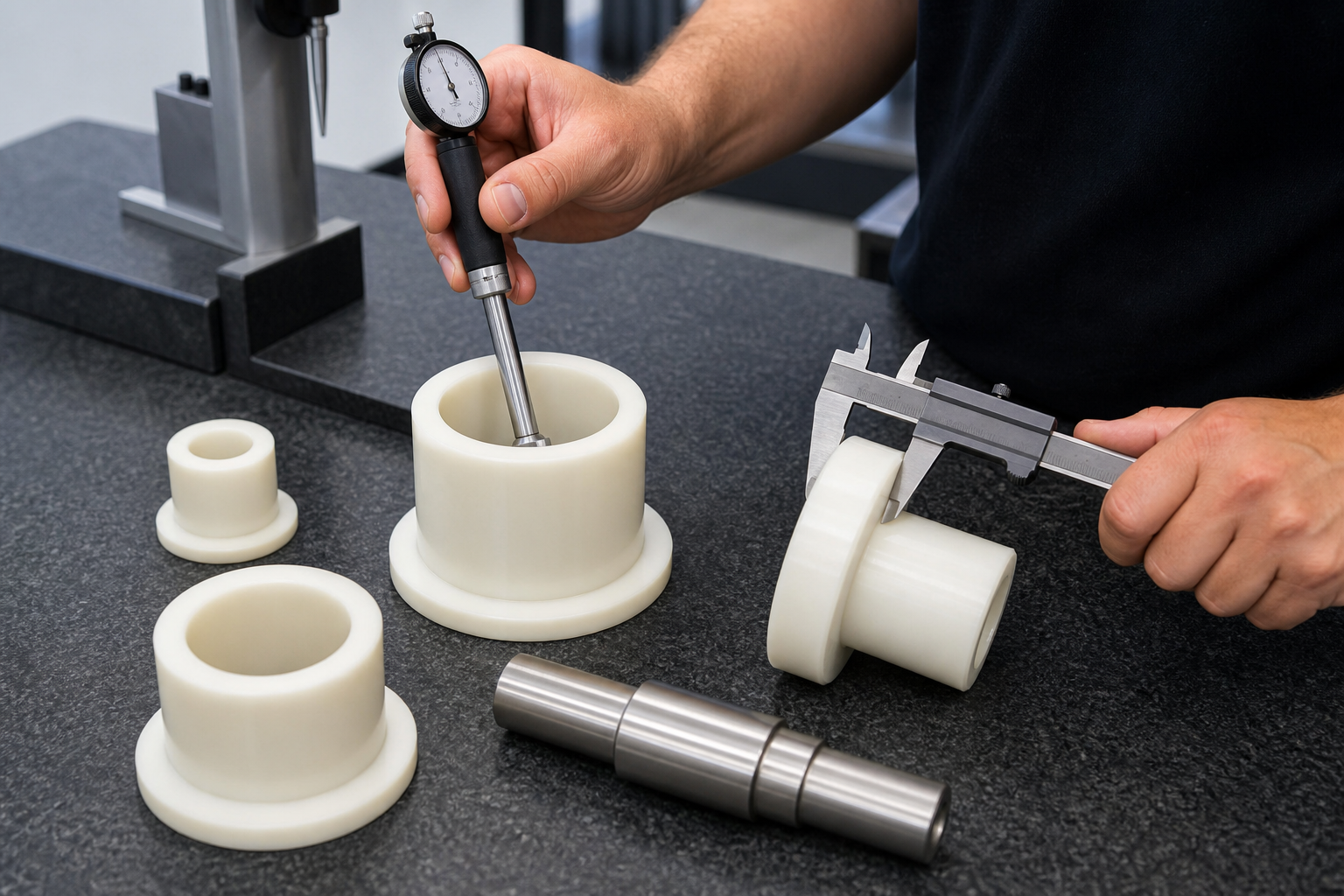
Nylon Plastic supports custom bushing projects where wear, clearance and material behavior decide whether the part works in service. A bushing is not only a turned plastic ring; bore growth, shaft finish, press fit, moisture, load and speed can all change the final fit.
- Wear-material selection: compare nylon, POM, UHMW, PTFE, PEEK and filled grades against load, speed, shaft material, lubrication and chemical exposure.
- Fit and tolerance review: check ID, OD, flange, groove, press-fit allowance, running clearance and dimensional change after conditioning or installation.
- Process choice: use CNC-Bearbeitung for prototypes, custom sizes and controlled tolerances, then review molding only when volume and design stability justify tooling.
- Inspection support: define bore checks, shaft-fit tests, material confirmation and first-article measurements before repeat orders.
This helps buyers choose a bushing material and manufacturing route based on the assembly, not only on a catalog plastic name.
Weiterführende Lektüre
- Plastic Bearing Materials Guide
- CNC-Bearbeitung von Nylon
- Delrin CNC Machining Services
- UHMW CNC Machining Services
Häufig gestellte Fragen
What materials can a custom plastic bushings manufacturer supply?
Common choices include nylon, POM, UHMW-PE, PTFE, PET and PEEK, plus filled wear grades for specific loads and environments.
How is plastic bushing clearance calculated?
Clearance should account for shaft tolerance, housing fit, press-fit bore reduction, temperature, moisture and operating load.
Are plastic bushings self-lubricating?
Many plastics run with little or no external lubrication, but performance still depends on material, shaft finish, load, speed and environment.
Should custom bushings be machined or molded?
Machining suits prototypes, custom sizes and moderate demand. Molding is considered when the design is stable and volume supports tooling.
What information is required for a bushing RFQ?
Provide the drawing, shaft and housing details, load, speed, temperature, environment, lubrication method and annual quantity.
For a custom plastic bushing RFQ
Upload the drawing and include shaft, housing, load, speed, environment and quantity. We will review material, fit and process before quoting.