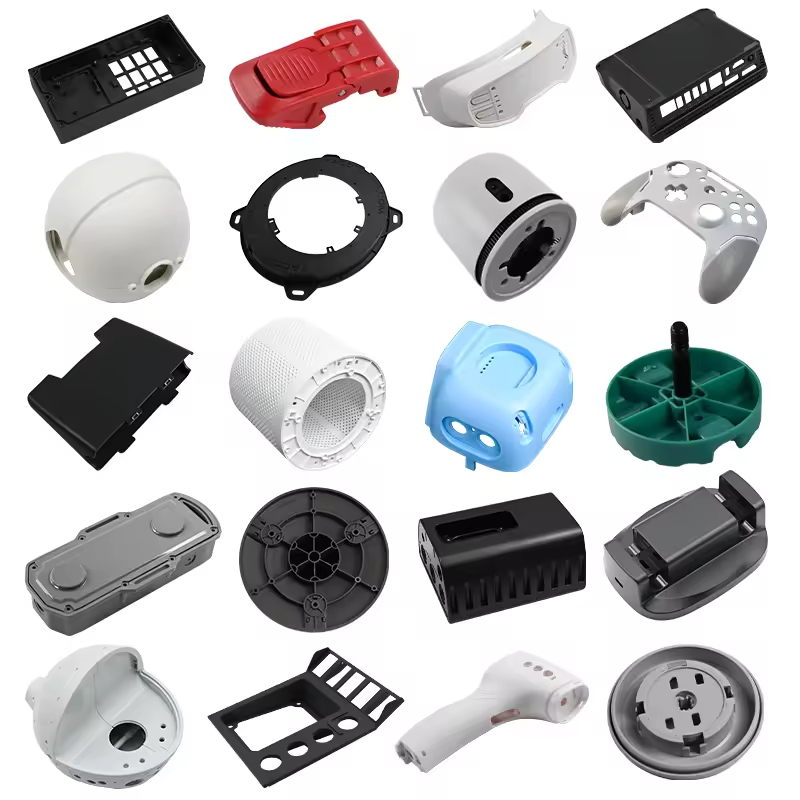
Carbon fiber reinforced nylon 66 is used when buyers need a lighter structural plastic with higher stiffness than unfilled or glass-filled nylon. The most common commercial direction is PA66-CF30, where 30% carbon fiber raises modulus, improves dimensional stability and lowers part weight compared with many glass-filled alternatives.
If the part also sees sunlight or humidity, review the UV stabilizer for nylon guide and nylon moisture absorption guide alongside this page.
The right question is not whether carbon fiber nylon 66 is stronger on paper. It is whether the part benefits from its stiffness-to-weight ratio enough to justify higher resin cost, conductivity changes and tighter molding control.
Auf einen Blick
| Entscheidungsbereich | PA66-CF30 Takeaway | Käuferprüfung |
|---|---|---|
| Steifigkeit | Much higher than unfilled PA66 | Use when deflection control matters more than ductility |
| Gewicht | Lighter than many glass-filled structural options | Useful for weight-sensitive assemblies |
| Formstabilität | Better than standard nylon grades | Still confirm humidity and use-state inspection |
| Tooling risk | More abrasive and process-sensitive | Review mold steel, gate wear and fiber orientation early |
| Optimale Passform | Rigid brackets, housings and load-bearing components | Do not use it by default where snap flexibility is required |
Unfilled PA66 vs PA66-GF20 vs PA66-CF30
Reinforcement should solve a defined part problem. Unfilled PA66 is usually the starting point when toughness, fatigue, wear, surface quality, and electrical insulation matter. PA66-GF20 adds moderate stiffness at a lower material and processing burden than carbon fiber. PA66-CF30 is justified when specific stiffness, directional dimensional control, weight, or a qualified electrical target matters enough to accept higher cost and tighter process control.
| Material Route | Best Starting Reason | Buyer Risk to Check |
|---|---|---|
| Unfilled PA66 | Toughness, fatigue, wear, and easier molding | Moisture-driven dimensions and insufficient stiffness |
| PA66-GF20 | Moderate deflection and shrinkage control | Fiber orientation, surface texture, and weld-line strength |
| PA66-CF30 | High specific stiffness, low CTE directionally, or a qualified ESD route | Cost, conductivity, brittleness, anisotropy, and tool wear |
Do not substitute one route from a headline tensile value. Compare the exact grade in the expected moisture state and test direction, then validate the molded geometry.
What PA66-CF30 Changes in Real Parts
PA66-CF30 increases modulus dramatically and can reduce weight versus heavier filled alternatives. It also changes the way the part shrinks, the way weld lines behave and the way the mold wears over time. Carbon fiber reinforcement is therefore a system decision involving resin, tool, gate and inspection state together.
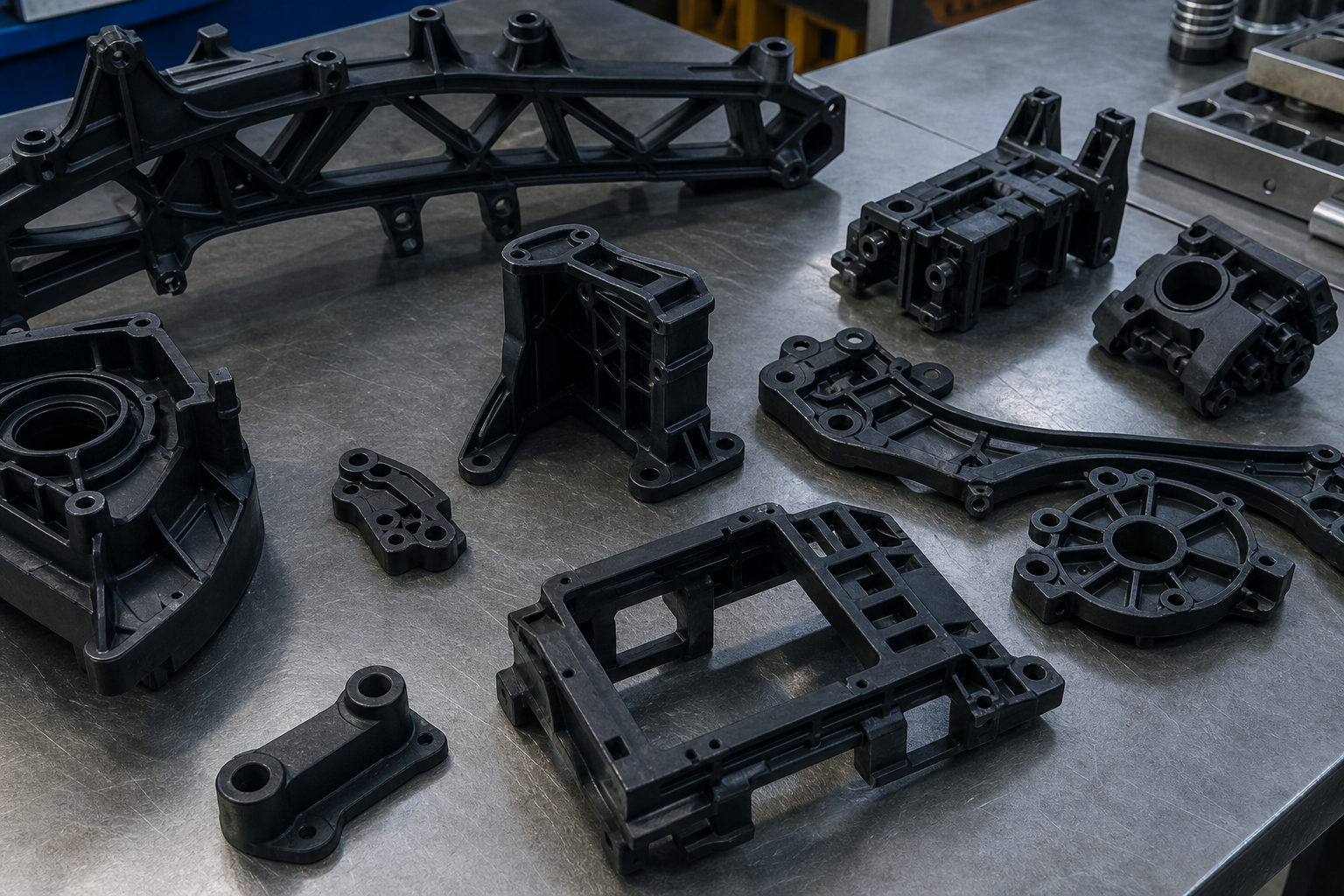
For structural brackets, machine frames, carriers and dimensional-control components, carbon fiber reinforced nylon 66 can outperform more commodity nylon options. For clips, living hinges or impact-prone parts, it may be the wrong material despite the attractive datasheet numbers.
Where Carbon Fiber Reinforced Nylon 66 Works Best
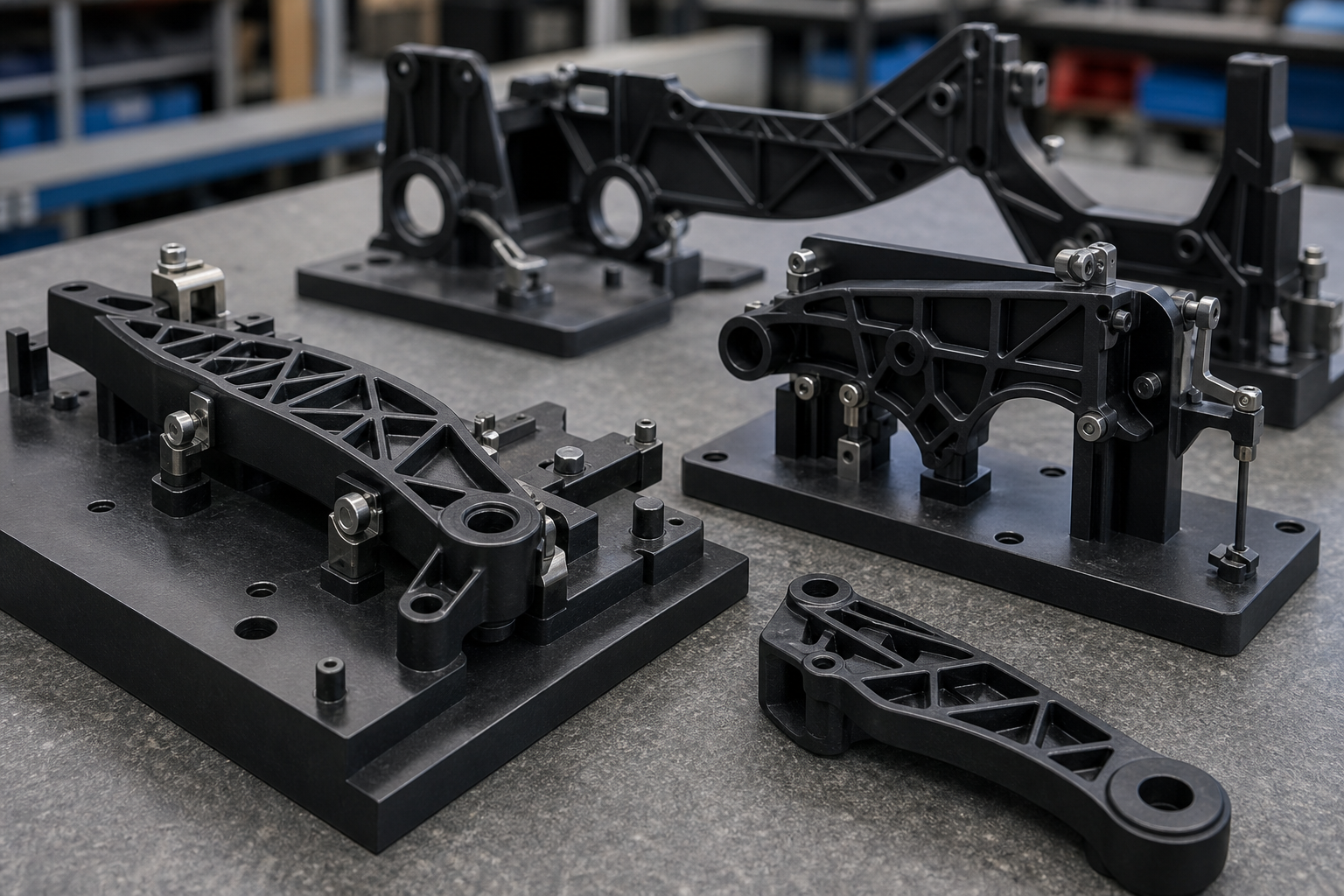
- Weight-sensitive structural parts: where stiffness per mass matters.
- Precision assemblies: where dimensional drift must be reduced.
- High-rigidity housings: where low flex is more important than impact softness.
- Metal-replacement projects: when geometry has already been redesigned for plastic load paths.
Common Risks and Practical Fixes
| Risiko | Warum das so ist | Praktische Lösung |
|---|---|---|
| Brittle local failure | High stiffness reduces forgiving flex | Review fillets, load path and notch sensitivity before material lock |
| Unexpected conductivity issue | Carbon fiber changes electrical behavior | Confirm whether insulation or ESD behavior matters in the application |
| Tool wear | Fiber reinforcement is abrasive | Use suitable tool steel and protect wear zones |
| Warp or directional behavior | Fiber orientation changes shrinkage and local strength | Review gate layout and mold flow before tooling release |
Carbon Fiber vs Glass Fiber Reinforced Nylon 66
Glass-filled PA66 is usually the lower-cost structural choice. Carbon fiber reinforced nylon 66 becomes attractive when weight reduction, higher stiffness-to-weight ratio or certain dimensional requirements justify the premium. The correct choice depends on the part function, not on which filler sounds more advanced.

Buyer Problems to Resolve Before Ordering PA66-CF30
| Incomplete Requirement | What Can Go Wrong | What to Add to the RFQ |
|---|---|---|
| The drawing says only PA66-CF30 | Heat stabilization, impact modification, color, conductivity, and approvals remain undefined | Incumbent grade, required approvals, electrical target, and color |
| Data sheets are compared without conditioning notes | Dry values are mistaken for in-use performance | Moisture state, temperature, test standard, and flow direction |
| Gate and weld lines are reviewed after tool release | Fiber orientation creates unexpected weakness or warpage | Load direction, critical surfaces, gate restrictions, and mold-flow review |
| Only a price per kilogram is requested | Lot control, drying, COA, packaging, and traceability are not comparable | Sample approval, COA fields, moisture limit, packaging, and lot-release plan |
Warum Nylon-Kunststoff?
Nylon Plastic has worked across material modification and finished plastic-part manufacturing since 2005. This allows the review to connect PA66-CF30 formulation with injection molding, CNC machining, or 3D-printing constraints instead of treating the data sheet as the complete design answer.
- Grade comparison: unfilled PA66, PA-GF20, and PA-CF30 can be screened against the actual failure mode.
- Custom compounding: formulation review is available when a standard grade does not meet stiffness, impact, color, wear, heat, or electrical requirements.
- Production feedback: gate direction, weld lines, drying, machining stress, and inspection condition can be considered before approval.
- Buyer documentation: the inquiry can define TDS, COA, sample, traceability, and lot-release expectations before volume supply.
Review the PA66-CF30 product route or compare it with PA66-GF20 when maximum carbon-fiber stiffness is not necessary.
Weiterführende Lektüre
- Carbon Fiber Nylon Parts
- Glass Fiber vs Carbon Fiber Reinforced Nylon
- PA66 GF15 im Vergleich zu GF30 und GF60
- PA66 GF33 im Vergleich zu GF40 und GF60
- Dienstleistungen im Bereich Nylon-Spritzguss
Häufig gestellte Fragen
What is PA66-CF30 used for?
PA66-CF30 is used for rigid brackets, carriers, housings, automation components, and other structural parts where stiffness-to-weight and directional dimensional control are more important than high ductility.
Is PA66-CF30 always better than PA66-GF20?
No. PA66-GF20 is often the more economical and forgiving choice when moderate stiffness is enough. PA66-CF30 should be selected when its higher specific stiffness, lower directional thermal expansion, weight, or electrical formulation solves a measured requirement.
Is carbon fiber reinforced nylon electrically conductive?
Carbon fiber can reduce electrical resistance, but the result depends on fiber content, dispersion, test method, humidity, and the complete formulation. Specify an actual resistance range rather than assuming ESD or conductivity from the PA66-CF30 name.
What information is needed for a PA66-CF30 quotation?
Send the drawing, annual volume, load direction, operating temperature, humidity, electrical target, critical dimensions, color, approvals, incumbent grade, and required COA or lot-traceability fields.
Request a PA66-CF30 Grade Review
Send the drawing and current material specification. We can compare unfilled PA66, PA66-GF20, and PA66-CF30 before the grade or production route is locked.