Introduction
Injection molding defects are an unavoidable reality in plastics manufacturing, but understanding their root causes transforms them from chronic problems into manageable process variables. This guide examines the ten most common injection molding defects??articularly in glass-fiber-reinforced nylon (PA66 GF)??nd provides actionable root-cause analysis alongside proven solutions. Whether you are troubleshooting on the production floor or designing a new tool, the frameworks below will help you reduce scrap rates and improve first-pass yield.
1. Sink Marks

Grundursache
Sink marks occur when the interior of a thick section cools and shrinks after the outer skin has already solidified. The still-molten core contracts during crystallization, pulling the rigid surface inward. In semi-crystalline resins like PA66, volumetric shrinkage can exceed 10??4%, making sink marks especially pronounced at rib-to-wall junctions and boss features.
The fundamental equation governing sink mark severity is the rib-to-wall thickness ratio. When a rib exceeds 60% of the nominal wall thickness, the local material reservoir outstrips the available packing pressure and cooling time, creating a volumetric deficit that the screw cannot replenish before gate freeze-off.
Solutions
- Rib thickness reduction: Maintain rib thickness at 50??0% of the nominal wall. For a 3.0 mm wall, design ribs to 1.5??.8 mm maximum. If structural stiffness must be preserved, use multiple thin ribs instead of one thick rib.
- Core out thick sections: Remove material from the center of bosses and thick bosses to eliminate isolated heat masses. A cored boss should maintain uniform wall thickness throughout its cross-section.
- Increase packing pressure and time: For PA66 GF30, apply packing pressure at 80??00% of injection pressure for 8??5 seconds, depending on gate size. Extend the gate-seal time by performing a gate-seal study??ncrease hold time until part weight plateaus.
- Optimize cooling: Target mold temperature of 80??00 C for PA66. Ensure conformal cooling channels run within one diameter of the cavity surface near thick sections. Reduce coolant inlet temperature to 20??0 C.
- Gate placement: Position gates at the thickest section to maximize packing efficiency. Avoid gating into thin walls that freeze before the thick section is packed.
- Process window adjustment: Raise melt temperature to the upper end of the recommended range (280??00 C for PA66 GF) to delay skin formation, and reduce injection speed slightly to allow uniform filling before the skin sets.
2. Flash

Grundursache
Flash results from molten polymer being forced into clearances within the mold??ost commonly along the parting line, around ejector pins, slides, or core interfaces??here the available clamp force cannot resist the injection pressure within the cavity. In PA66 with its characteristically low melt viscosity (especially at 290 C and above), even small clearances become flow paths.
There are three distinct failure modes: insufficient clamp tonnage (process), worn or damaged mold surfaces (tool condition), and improper mold setup or parallelism (setup). Each demands a different corrective path, and effective troubleshooting requires isolating which mode is active.
Solutions
- Clamp force verification: Calculate the required clamp force as projected area x cavity pressure. As a rule of thumb, use 3?? tons per square inch (41??9 MPa). For a 100 in? projected area, ensure 300??00 tons of clamp force. If the machine is undersized, move the tool to a larger press.
- Mold inspection and repair: Inspect parting line surfaces under magnification for peening, erosion, or galling. Re-grind or replace worn parting line inserts. Check ejector pin clearances??eplace pins when clearance exceeds 0.025 mm (0.001 in). Verify that slides and lifters seat fully with no rocking.
- Reduce injection pressure: Lower injection velocity and transfer to pack earlier??t 95??8% fill rather than 99%. This reduces peak cavity pressure spikes. For PA66 GF, target transfer pressure below 70 MPa (10,000 psi) cavity pressure where possible.
- Lower melt temperature: Reduce barrel temperature by 5??0 C increments within the manufacturer-specified range (typically 270??90 C for PA66). Lower viscosity brings less tendency to penetrate clearances.
- Mold setup: Verify platen parallelism with a dial indicator. Ensure tie-bar strain is balanced (within 5% across all four bars). Check that the mold sits square on the platens with full surface contact.
- Preventive maintenance: Establish parting line inspection intervals based on shot count. For abrasive GF compounds, inspect every 50,000??00,000 cycles and perform preventative re-grinding before flash becomes chronic.
3. Short Shots
Grundursache
Short shots happen when the flow front solidifies before reaching the end of the cavity. The root cause is a mismatch between the polymer’s ability to flow and the cavity’s demand for fill volume within the available solidification time. For glass-fiber-reinforced nylons, the elevated thermal conductivity of the compound (GF conducts heat roughly 20 times faster than unfilled polymer) accelerates cooling, shortening the available flow window.
Key contributory factors include inadequate injection pressure or velocity, undersized gates that restrict flow, thin wall sections that freeze prematurely, insufficient venting creating back-pressure, and inadequate melt temperature resulting in high viscosity at the flow front.
Solutions
- Increase injection pressure and speed: Raise injection pressure in 5 MPa increments while monitoring for flash. For thin-wall PA66 GF parts, injection speeds of 100??00 mm/s are common. Use profiled injection??ast during cavity fill, slower near transfer??o balance filling speed against gas entrapment.
- Gate design and sizing: Verify that gate land length is no more than 1.0??.5 mm for PA66. Increase gate diameter to at least 50??0% of the wall thickness at the gate location. For GF compounds, use a minimum gate diameter of 1.5 mm to avoid fiber breakage and premature freeze-off. Consider switching from edge gates to fan or tab gates for thin-wall applications.
- Raise melt temperature: Increase to 285??00 C for PA66 GF, staying within the material supplier’s degradation limits. Verify actual melt temperature with a needle pyrometer??arrel set points often read 10??0 C below actual melt temperature.
- Improve venting: Add vents at the end of fill. Vent depth for PA66 should be 0.015??.025 mm. Vent land length should be 1.0??.5 mm, with a relief channel behind the land to prevent clogging. Clean vents every 8??2 hours of production for GF compounds.
- Increase mold temperature: Raise to 90??10 C for PA66 to delay skin solidification and extend flow length. Use mold surface temperature measurement (not just coolant temperature) to verify.
- Verify shot size: Ensure the cushion is 3?? mm. If the cushion bottoms out (zero cushion), the screw cannot deliver packing pressure and short shots become inevitable.
4. Warpage

Grundursache
Warpage is the dimensional distortion of a molded part arising from differential shrinkage. In glass-fiber-reinforced nylons, the root cause is overwhelmingly anisotropic shrinkage: the polymer matrix shrinks approximately 0.8??.5% along the fiber orientation direction but 1.5??.0% perpendicular to it. This two-to-one shrinkage differential creates internal stresses that manifest as warpage when the part is ejected and post-mold crystallization completes.
The fiber orientation is determined by the flow pattern during filling. Where flow is unidirectional, fibers align and shrinkage becomes highly directional. Where flow diverges or converges, orientation varies locally and warpage predictability degrades. Gate location is therefore the single most influential tool design factor controlling warpage severity.
Solutions
- Gate location optimization: Perform mold-filling simulation (Moldflow or Moldex3D) to visualize fiber orientation tensor. Position gates to create symmetric, balanced flow. For rectangular parts, a center gate produces radial flow with more balanced shrinkage than edge gating. Avoid single edge gates on long parts??he flow direction creates maximum shrinkage differential along the part length.
- Wall thickness uniformity: Maintain uniform nominal wall thickness to avoid differential cooling rates that compound fiber-orientation warpage. Where thickness transitions are unavoidable, use generous radii and gradual tapers over at least 3x the thickness difference.
- Gleichmäßigkeit der Kühlung: Ensure the temperature difference between cavity and core sides of the mold is less than 10 C. A hot core and cold cavity create thermal bending moments. Use independent mold temperature controllers for each half.
- Packing optimization: Extend hold time until the gate seals (determined by gate-seal study). Adequate packing compensates for volumetric shrinkage and reduces residual stress. For PA66 GF30, target hold pressure at 60??0% of injection pressure for 8??5 seconds.
- Material selection: Where warpage is chronic, consider switching to a lower-aspect-ratio fiber or a mineral/GF hybrid filler system. Mineral fillers produce more isotropic shrinkage at the cost of some tensile strength.
- Post-mold fixturing: For parts that cannot be fully corrected through tooling and process, use post-mold cooling fixtures that constrain critical dimensions until the part cools below the glass transition temperature (approximately 50??0 C for PA66).
5. Weld Lines (Knit Lines)

Grundursache
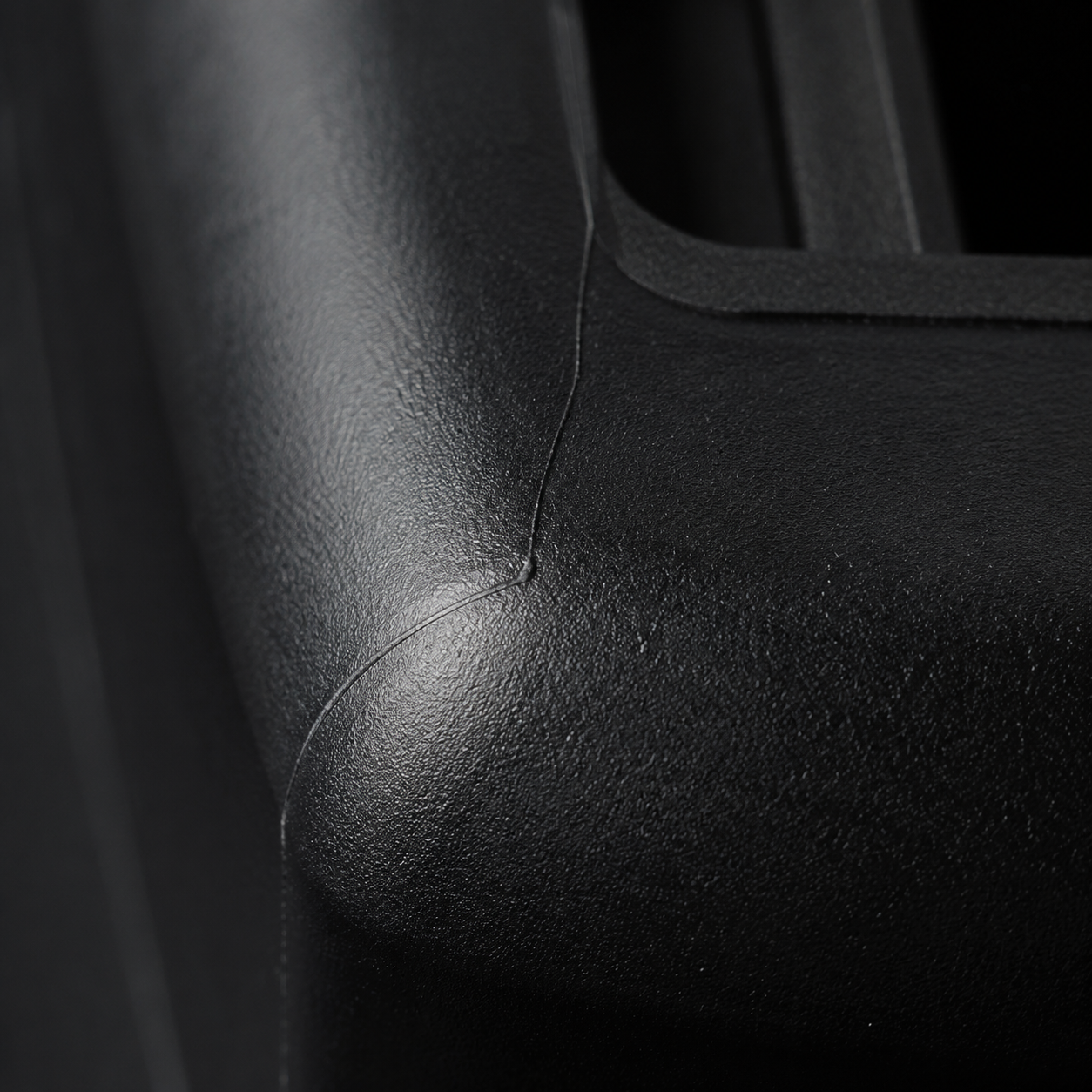
Weld lines form wherever two molten flow fronts meet??ypically downstream of core pins, holes, or multi-gated cavities. The converging fronts have cooled and partially solidified at their leading edges. When they meet, limited molecular diffusion and chain entanglement occur across the interface. In glass-fiber-reinforced nylon, fibers at each flow front orient parallel to the interface rather than bridging across it, creating a plane of weakness.
The strength penalty is severe. Published research and industrial data consistently show that weld-line tensile strength in PA66 GF30 is reduced by 40??0% compared to the bulk material. Elongation at break can drop by 80% or more, transforming a ductile material into a quasi-brittle one at the weld-line plane. Impact strength degradation is even more pronounced, with notched Izod values at the weld line often falling below 30% of the bulk value.
Solutions
- Increase melt temperature: Raise to the upper end of the allowable range (290??00 C for PA66) to reduce viscosity and promote molecular diffusion at the flow-front interface. Every 10 C increase in melt temperature measurably improves weld-line strength, though with diminishing returns near the degradation threshold.
- Increase mold temperature: Raise mold temperature to 100??20 C for PA66. Hotter tool surfaces delay skin formation on the advancing flow fronts, allowing the fronts to meet while still molten and capable of intermixing.
- Increase injection speed: Faster filling reduces the time available for flow-front cooling before the fronts meet. Use velocity-controlled filling at 100??00 mm/s for thin-wall parts.
- Vent weld-line locations: Trapped air at the converging interface prevents intimate contact. Add vents precisely at predicted weld-line positions, using full-perimeter venting where possible.
- Relocate gates to shift weld lines: Use flow simulation to predict weld-line locations. Move gates or adjust the number of gates to shift weld lines away from high-stress regions of the part. A single gate eliminates weld lines entirely (though at the cost of flow-length concerns).
- Modify part geometry: Add a flow leader (localized wall-thickness increase) that guides the converging fronts together at a higher temperature. Alternatively, add a cold-slug well downstream of the weld line to trap the cold leading edge of the flow front before the fronts merge.
- Design acceptance: If the weld line cannot be eliminated, the part design must accommodate the 40??0% strength reduction at that location through increased cross-section, external reinforcement, or relocation of the weld line to a low-stress zone.
6. Burn Marks (Diesel Effect)
Grundursache
Burn marks??lso called the diesel effect??ccur when trapped air or volatiles in the mold cavity are compressed so rapidly during filling that the gas temperature exceeds the auto-ignition point of the polymer or its decomposition products. The resulting localized thermal degradation produces charred, discolored spots, typically at the end of fill or at blind pockets where gas cannot escape.
The adiabatic compression of air follows the relationship T2/T1 = (P2/P1)^((γ-1)/γ), where γ is approximately 1.4 for air. In a poorly vented cavity, compression from 0.1 MPa to 70 MPa in milliseconds can theoretically raise the trapped air temperature to over 500 C??ell above the degradation temperature of PA66 (approximately 350 C). Even if auto-ignition is not reached, prolonged exposure of the melt to trapped hot air accelerates oxidative degradation.
Solutions
- Adequate venting: This is the primary and most effective fix. Install vents at all end-of-fill locations, blind pockets, and areas where flow fronts converge. For PA66, vent depth should be 0.015??.025 mm with a land length of 1.0??.5 mm, backed by a full-depth relief channel (minimum 0.5 mm deep, 3 mm wide).
- Vent maintenance: For glass-fiber compounds, vents clog with fiber debris and volatiles within hours. Clean vents at every shift change (8??2 hours). Install vent monitoring??f a previously clean-running tool develops burn marks, inspect vents immediately. Consider self-cleaning vent designs with wider land areas.
- Reduce injection speed: Slower filling reduces the rate of compression, giving air more time to escape through existing vents. Use a profiled injection velocity??ast through the runner, slower in the cavity??o reduce gas compression.
- Optimize vent placement with simulation: Use mold-filling simulation with air-trap prediction to identify gas entrapment locations before cutting steel. Add vents at each predicted air trap.
- Reduce melt temperature: While counterintuitive (cooler polymer is more viscous and traps more air), reducing melt temperature from 300 C to 280 C lowers the starting temperature of the gas-polymer system and reduces the likelihood of exceeding the degradation threshold.
- Vacuum venting: For chronic burn-mark problems in complex tools, install a vacuum-assist system that evacuates the cavity before and during injection. A vacuum of -0.08 MPa or better is typically sufficient.
- Material drying: Moisture in PA66 generates steam at processing temperatures. Ensure material is dried to <0.15% moisture (typically 4 hours at 80 C in a desiccant dryer with -40 C dew point). Steam generation during filling compounds the gas-compression problem.
7. Jetting
Grundursache
Jetting occurs when molten polymer enters the cavity through a gate as a high-velocity stream rather than as an expanding flow front. The jet shoots across the open cavity, cools, and folds onto itself in a chaotic pattern??roducing a characteristic snake-like or worm-like surface defect. Unlike normal filling, where the flow front advances smoothly from the gate outward, jetting creates a discontinuous fill pattern in which cold material is deposited onto the cavity surface before the main melt body arrives.
This defect is fundamentally a gate design and injection speed problem. When the gate cross-section is too small relative to the injection rate, the melt velocity through the gate becomes supersonic by polymer-flow standards, and the jet of polymer lacks the back-pressure needed to transition from a free jet to a spreading flow front. Jetting is particularly prevalent with edge gates that discharge directly into an open cavity and with sub-gates and tunnel gates that have small orifices.
Solutions
- Gate design??mpingement: The most effective fix is to direct the melt stream against a cavity wall or core pin immediately downstream of the gate. An impingement distance of 5??0 mm from the gate to the opposing wall breaks up the jet and forces the formation of a spreading flow front.
- Increase gate cross-section: Enlarge the gate to reduce melt velocity. For edge gates, increase both width and depth. A gate land length of no more than 1.0 mm also helps by minimizing the acceleration zone.
- Switch to fan or tab gates: Fan gates expand the flow channel width gradually, naturally decelerating the melt before it enters the cavity. Tab gates include an impingement wall by design. Both are superior to simple edge gates for jetting-prone materials.
- Reduce injection speed through the gate: Use profiled injection??low through the gate (20??0 mm/s), then accelerate once a spreading flow front is established. Do not allow peak velocity directly at the gate.
- Increase melt temperature: Higher melt temperature reduces viscosity, allowing the jet to spread rather than maintain a coherent stream. However, this is a secondary solution??ate design should be addressed first.
- Use a melt flipper or flow leader: A small geometric feature (a raised pad or recess) directly in front of the gate acts as a diverter, breaking up the jet and nucleating a spreading flow front.
8. Brittleness
Grundursache
Brittleness in molded nylon parts is rarely a single-factor problem. The most common cause??specially for PA66??s material degradation due to improper drying or excessive residence time. Nylon is hygroscopic; inadequate drying leaves residual moisture that hydrolyzes the polymer chains during processing at 270??00 C. The result is molecular weight reduction, loss of elongation, and embrittlement. A second common pathway is thermal degradation from excessive melt temperature or residence time exceeding 5?? minutes in the barrel. Oxidative degradation produces discoloration (yellowing to brown) alongside brittleness.
For glass-fiber-reinforced grades, fiber breakage during plastication also reduces impact strength. Aggressive screw designs with high compression ratios (above 2.5:1) and excessive back pressure (above 1 MPa) can reduce average fiber length below the critical length needed for effective reinforcement.
Solutions
- Verify drying: Confirm that PA66 is dried to <0.15% moisture using a desiccant dryer with -40 C dew point at 80 C for 4 hours. Use a moisture analyzer??o not rely on dryer settings alone.
- Reduce residence time: Ensure that shot size is 30??0% of barrel capacity. If shot size is below 20%, the material in the barrel is cycling too slowly and degrading. Purge the barrel and reduce barrel temperature set points during extended stoppages.
- Check melt temperature with a needle pyrometer: Do not trust barrel set points alone. The combination of screw shear heating and barrel conduction can produce actual melt temperatures 10??0 C above set points. Reduce barrel temperatures if actual melt exceeds 300 C.
- Optimize screw design for GF compounds: Use a low-compression screw (compression ratio 1.8??.2:1) with a long transition zone to minimize fiber breakage. Reduce back pressure to 0.3??.7 MPa.
- Clean hot-runner systems: Dead spots in hot-runner manifolds create residence-time traps where material degrades and intermittently enters the melt stream. Purge and inspect hot runners during preventive maintenance.
- Perform melt-flow testing: Compare MFI of molded parts to virgin pellets. A significant increase in MFI (more than 20%) indicates molecular weight reduction and degradation.
9. Splay (Silver Streaks)
Grundursache
Splay??lso called silver streaking??ppears as fan-shaped or linear silver-white streaks radiating from the gate or along the flow path. In nylon, splay has two distinct root causes requiring different corrective actions: moisture splay (steam bubbles sheared during flow) and degradation splay (gaseous decomposition products from overheated polymer).
Moisture splay in PA66 is characterized by streaks that appear milky-white, are generally near the gate, and correlate with inadequate drying. Degradation splay is typically yellow-brown at the source, becoming silver-white as it stretches, and is associated with excessive melt temperature, hot spots in the barrel or hot runner, or excessive residence time. A third mechanism??ir-entrapment splay??ccurs when air drawn into the melt stream during screw recovery is not vented through the hopper or check ring.
Solutions
- Drying (moisture splay): Dry PA66 to <0.15% moisture. Confirm dryer performance: dew point below -40 C, air flow at 3.7 m?/h per kg/h of material throughput, material temperature at 80 C for a minimum of 4 hours.
- Reduce melt temperature (degradation splay): Lower barrel temperatures in 5 C increments. Check for hot spots using a thermal-imaging camera on the barrel exterior. Replace worn heater bands that cause localized overheating.
- Reduce screw speed and back pressure: Excessive screw RPM generates shear heating that cannot be removed by barrel cooling. Reduce screw speed to 50??00 RPM and back pressure to 0.3??.7 MPa for PA66 GF.
- Address air entrapment: Reduce screw decompression (suck-back) to 2?? mm maximum. Excessive decompression draws air into the nozzle that is then injected into the cavity. Ensure the hopper throat is adequately cooled to prevent bridging, which can cause intermittent air entrapment.
- Hot-runner inspection: Check hot-runner temperature controllers and thermocouples for accuracy. A single nozzle running 20 C hotter than indicated can be the source of intermittent degradation splay.
10. Delamination
Grundursache
Delamination is the separation of the molded part into distinct surface layers that can be peeled apart??nalogous to flaking mica. In nylon injection molding, delamination arises from three principal mechanisms: (1) contamination with an incompatible polymer or foreign material that does not bond to the nylon matrix, (2) excessive mold-release agent or lubricant that migrates to the surface during filling and prevents inter-layer bonding, and (3) extreme shear-induced degradation at the melt-wall interface that creates a low-molecular-weight skin unbonded to the core.
Contamination-driven delamination is the most common and most dangerous: a single pellet of polypropylene or polyethylene introduced into the nylon feed stream will not melt-bond and creates a delamination plane at every shot. The economic impact can be severe because the problem is intermittent and contamination may have spread through hundreds of kilograms of material before detection.
Solutions
- Material handling??ontamination control: Use dedicated material-handling systems for nylon. Never share hoppers, loaders, gaylords, or grinders with polyolefins. Implement a positive material-identification protocol??erify resin type before loading. If contamination is confirmed, the entire lot must be quarantined and the feed system purged.
- Purge thoroughly between material changes: Use a commercial purging compound (not just the next material) when switching between incompatible polymers. For nylon-to-nylon transitions, purge with 3?? barrel capacities of the incoming material. For incompatible transitions (olefin to nylon), use an aggressive purging compound.
- Reduce or eliminate mold release: If external mold release is being used, switch to internal mold release incorporated in the compound. If external release is unavoidable, apply sparingly with an automated system and ensure full evaporation of the carrier solvent before mold closure.
- Check regrind quality: If regrind is being used, verify that the regrind particle size distribution is consistent (3?? mm average). Fines and dust from the grinding process degrade faster and can create localized delamination. Limit regrind to 20% maximum for critical applications.
- Reduce injection speed: High shear rates at the wall can create a highly oriented, degraded skin layer. Reduce injection velocity to lower shear stress below 0.2 MPa at the wall. Mold-filling simulation can quantify wall shear stress.
- Increase mold temperature: A hotter mold surface (100??10 C for PA66) allows the melt to remain mobile at the wall, promoting inter-layer bonding and reducing shear stress.
Defect Quick-Reference Table
| Fehler | Primary Root Cause | First Check | Typical Fix |
|---|---|---|---|
| Spülbecken-Eindrücke | Thick section vs. wall ratio | Rib-to-wall ratio > 60%? | Reduce rib thickness; increase pack time |
| Flash | Insufficient clamp / mold wear | Parting line condition | Repair mold; verify clamp tonnage |
| Kurzbeiträge | Flow freezes before fill complete | Cushion position | Increase injection pressure/speed; enlarge gate |
| Verziehen | Anisotropic shrinkage (GF orientation) | Gate location / flow symmetry | Reposition gate; balance cooling |
| Schweißnähte | Cold flow fronts meeting | Flow-front temperature at merge | Raise melt/mold temp; vent at weld line |
| Burn Marks | Trapped air compression (diesel effect) | Vent cleanliness and depth | Clean/add vents; reduce injection speed |
| Jetting | High-velocity free jet from gate | Gate type and impingement distance | Add impingement wall; enlarge gate |
| Brittleness | Material degradation (moisture/heat) | Drying verification; residence time | Dry material; reduce melt temp / residence time |
| Splay | Moisture or thermal degradation gas | Splay color: white (moisture) vs. yellow (degradation) | Dry material or reduce melt temperature |
| Delamination | Contamination / incompatible polymer | Material feed system contamination | Purge system; quarantine contaminated material |
Reject vs. Accept: A Concession Framework
Not every molded defect renders a part unusable. The decision to accept or reject must balance functional requirements, cosmetic standards, and economic reality. A structured concession framework ensures consistency across shifts, suppliers, and production runs while preventing the most common failure mode in quality decision-making: rejecting parts that would perform adequately or accepting parts that will fail in service.
Three-Tier Classification
| Classification | Criteria | Decision | Beispiele |
|---|---|---|---|
| Critical Defect | Renders part unsafe or non-functional; violates regulatory or customer safety requirements | Automatic reject??o concession possible | Weld lines in load-bearing sections (40??0% strength loss); brittleness from degraded PA66; delamination in structural areas; burn marks that have charred and weakened material |
| Major Defect | Impairs function or significantly reduces service life; visible to end user on a Class A surface | Reject by default; concession only with documented engineering assessment and customer approval | Sink marks exceeding 0.1 mm depth on visible surfaces; warpage exceeding dimensional tolerance; short shots (incomplete part); flash on sealing surfaces |
| Minor Defect | Cosmetic only; does not affect fit, form, or function; not on a Class A surface or is below agreed visual acceptance thresholds | Accept or concession??ocument and monitor for trend | Light splay on non-visible surfaces; minor sink marks below 0.05 mm on hidden faces; superficial weld lines in non-structural areas; jetting marks on internal surfaces |
Concession Decision Process
- Identify the defect type and severity: Use the quick-reference table above to classify the defect and determine whether the root cause is stable (consistent defect) or deteriorating (worsening trend).
- Evaluate against the drawing and specification: Check dimensional tolerances, material specifications, and any customer-specific appearance standards (e.g., VDA 16, GS 97060 for automotive).
- Assess functional impact: For structural defects (weld lines, brittleness), perform the relevant mechanical test on defective samples. Tensile testing at the weld line, impact testing of affected regions, or simple functional assembly trials often provide decisive data.
- Trend analysis: Is this an isolated lot or a systemic issue? If SPC data shows the process mean drifting toward the out-of-spec limit, reject the lot even if the current parts are borderline??he next production will be worse.
- Document the concession: Every concession must be recorded with part number, lot/batch, defect description, quantity, disposition (use-as-is, rework, scrap), approval authority, and customer acknowledgment where required. Concessions without root-cause corrective action are deferred problems.
- Implement corrective action: A concession is a temporary disposition, not a permanent solution. Every concession must have an associated corrective action plan with owner and due date.
PA66 GF-Specific Acceptance Guidance
For PA66 GF30 parts, additional considerations apply. Weld lines in non-structural areas (decorative bosses, non-load-bearing ribs) may be accepted with cosmetic inspection only. However, any weld line within 10 mm of a fastener, insert, or load path must be evaluated by tensile testing across the weld line. A minimum of 60% of the bulk tensile strength should be demonstrated for acceptance. Warpage in PA66 GF parts must account for post-mold moisture absorption: PA66 absorbs up to 2.5% moisture at equilibrium, which causes dimensional growth of 0.3??.7% and can partially relieve molded-in stresses. Dimensional inspection should therefore be performed both dry-as-molded and after conditioning (48 hours at 23 C / 50% RH minimum) if the application involves ambient service conditions.
Defect identification matrix for the first response
A defect report should begin with the visible symptom and the condition in which it was found. The same mark can have different causes when it appears at the gate, the end of fill, a rib, an insert, a parting line or a cooling hot spot. Record the location on a part photograph and then compare it with cavity, resin lot, machine, shift, cycle and process change. This gives the supplier a way to separate material, machine, mold, process and part-design causes before a trial is selected.
| Symptom or photo evidence | Likely mechanism to investigate | First evidence | Relevant diagnostic guide |
|---|---|---|---|
| Bow, twist, corner lift or hole-pattern movement | Differential shrinkage, cooling, packing, fiber orientation or measurement restraint | Free-state profile, cavity map, conditioning record and cooling temperatures | Warpage guide |
| Dark mark at the end of fill or near a blind feature | Trapped gas, insufficient venting, excessive local shear or residence-time damage | Short shots, vent map, pressure trace, purge evidence and cavity comparison | Burn-mark guide |
| Material outside the parting line or shutoff | Excessive cavity pressure, poor mold fit, worn shutoff, vent condition or clamp issue | Parting-line map, cavity, pressure/transfer record and mold inspection | Flash guide |
| Streak, band or gloss change from a gate | Free jetting, hesitation, skin freezing, contamination or color dispersion | Gate-entry short shots, fill profile, melt condition and light-angle inspection | Flow marks and jetting guide |
| Silver streak, color streak or layered surface | Moisture, gas, contamination, poor dispersion or incompatible material interface | Dryer record, moisture, lot traceability, purge sample and cross-section | Color-streak guide |
| Surface layer separates or peels | Material incompatibility, contamination, moisture, cold slug or weak interface | Cross-section, peel evidence, resin lots, drying and material-change record | Delamination guide |
This matrix is a first-response tool, not a substitute for the drawing, resin supplier data or controlled trials. Cosmetic limits should identify viewing distance, lighting, permitted zones and boundary samples. Functional limits should identify the datum scheme, load, mating condition, sealing requirement and service temperature. A supplier should not call a part acceptable or rejectable from a photograph without knowing which of those conditions apply.
Diagnostic sequence before changing a parameter
- Confirm the symptom. Photograph the part with a sample ID, cavity, gate and flow direction. Mark the defect location and state whether it is cosmetic, dimensional or functional.
- Check the pattern. Compare the same location across cavities, shots, shifts and resin lots. A cavity-specific pattern points toward the mold; a lot-specific pattern points toward material condition; a time-dependent pattern may point toward heat, venting or wear.
- Confirm the material. Record manufacturer, grade, color, reinforcement, lot, drying start/end, moisture result, regrind and sealed-storage condition.
- Confirm the machine and process. Record machine, screw size, shot utilization, fill time, pressure trace, transfer method, cushion, hold profile, mold temperature and cycle.
- Use a short-shot or controlled sample sequence. Identify when the symptom begins in relation to gate entry, feature filling, end of fill, packing or ejection.
- Inspect the mold interface. Review gate, runner, vent, parting line, shutoffs, inserts, cooling circuits, ejectors and cavity surface in the affected zone.
- Change one variable and retain the evidence. Record the original setting, the single change, the sample range, the measured response and any new defect before approving the direction.
Changing several parameters at once can produce a temporarily good part while removing the ability to identify the cause. A controlled trial should use production-intent material and the same mold, machine, inspection method and sample condition used for approval. When a correction is accepted, update the process window, drawing note, mold-maintenance instruction or material-control instruction that prevents recurrence.
Data package for supplier escalation
| Information | Why it matters | Minimum useful detail |
|---|---|---|
| Part and drawing | Defines functional surfaces and acceptance limits | Controlled CAD/drawing, revision, datums, critical dimensions, cosmetic zones and assembly consequence |
| Material | Links viscosity, moisture, shrinkage and degradation risk to the symptom | Manufacturer, grade, color, reinforcement, lot, drying record and regrind |
| Sample identity | Reveals cavity, lot, machine and time patterns | Shot number, cavity, machine, shift, date, defect rate and retained samples |
| Process record | Shows whether the process is inside a stable window | Fill profile, transfer, pressure, hold, temperatures, cushion, cooling, cycle and alarm history |
| Mold evidence | Separates a process change from a tool or maintenance issue | Gate, vent, parting line, cooling, insert, ejector and wear observations |
| Inspection method | Prevents measurement condition from being mistaken for defect movement | Instrument, datums, support, temperature, humidity, conditioning and fixture force |
For a buyer, this package also makes supplier escalation more efficient. It gives the engineering team enough information to decide whether a process-window trial, material confirmation, mold inspection, gate review, cooling review or DFM correction should happen first. The requested response should identify the suspected mechanism, the evidence that supports it, the proposed trial, the acceptance criteria and the condition under which a mold change would be approved.
Prevention and approval checklist
- Use a controlled drawing with functional datums, cosmetic zones and assembly limits.
- Approve resin grade, color, reinforcement, drying condition and lot traceability.
- Define fill, transfer, packing, cooling and plasticizing values with normal ranges and stop limits.
- Validate cavity balance using short shots, part weight, pressure or other relevant signals.
- Record gate-seal, mold-temperature, cooling-balance and dimensional evidence where applicable.
- Inspect vents, parting lines, shutoffs, ejectors and cooling circuits at a frequency matched to the defect risk.
- Use cavity-specific samples and do not average away a single-cavity problem.
- Approve process or mold corrections against the drawing, boundary sample and functional test.
- Retain the corrected sample, process record, inspection report and change history.
Escalate to DFM when the stable process window cannot meet the drawing, when a defect follows a gate or wall-thickness decision, when cooling remains unbalanced, or when a material correction would compromise the required performance. The objective is not to eliminate every visual variation with unlimited process adjustment. It is to establish a repeatable part condition that meets the customer’s functional and appearance requirements with a documented risk path.
What should be checked first when a defect appears?
Confirm the visible symptom, sample identity, cavity, resin lot, machine, process record and inspection condition before changing a setting. Then use a short-shot or controlled comparison to locate where the symptom begins in the filling, packing, cooling or ejection sequence.
Häufig gestellte Fragen
Why do injection molding defects keep recurring even after we fix the process?
Recurring defects are almost always a symptom of treating the effect rather than the root cause. In injection molding, five factors interact: material, mold, machine, process parameters, and operator practice. A defect “fix” that changes only one factor (e.g., increasing pack pressure to hide sink marks) collapses when another factor shifts??aterial lot change, ambient humidity, mold wear, or a different operator. The systematic approach uses Ishikawa (fishbone) analysis across all five factors and verifies that the corrective action addresses the root cause, not the symptom.
Additionally, many “fixes” are applied without a gate-seal study or a design of experiments (DOE) to establish a robust process window. A process that works at one set point but fails with a 5 C mold-temperature shift is not robust. Use DOE methodology (full factorial or Taguchi) to identify the process window where defect rate is below the acceptable quality limit across the full range of normal variation.
Finally, verify that your preventive maintenance schedule matches your defect recurrence pattern. If vents clog every 12 hours but cleaning is scheduled weekly, burn marks will “recur” regardless of other corrective actions. Align PM intervals with actual degradation rates.
What AQL level should we use for injection molded nylon parts?
Acceptable Quality Limit (AQL) levels depend on the application criticality and customer requirements, but the following framework applies to most nylon injection molding:
| Anwendung | Critical Defects | Major Defects | Minor Defects |
|---|---|---|---|
| Automotive safety (airbag, brake) | 0 (c = 0) | AQL 0.25 | AQL 0.65 |
| Automotive non-safety (brackets, covers) | 0 (c = 0) | AQL 0.65 | AQL 1.0 |
| Industrial / electrical enclosures | 0 (c = 0) | AQL 1.0 | AQL 1.5 |
| Consumer goods / general purpose | 0 (c = 0) | AQL 1.5 | AQL 2.5 |
Critical defects always carry c = 0 acceptance (zero defects in the sample) regardless of application. For automotive, use ISO 2859-1 / ANSI ASQ Z1.4 with General Inspection Level II for most applications and Level S-3 or S-4 for small-lot production. Always confirm AQL levels with the customer quality agreement??ustomer requirements take precedence over general guidance.
For process monitoring rather than lot acceptance, pair AQL sampling with SPC control charts (X-bar/R or p-charts) to detect process drift before it produces rejectable lots.
Why are glass-fiber-reinforced nylons more difficult to mold without defects, and what adjustments should I make?
Glass-fiber-reinforced nylons present three compounding challenges that make defect-free molding more demanding than unfilled grades:
1. Anisotropic shrinkage: The 2:1 to 3:1 shrinkage ratio parallel vs. perpendicular to fiber orientation makes warpage prediction and control fundamentally more difficult. Solution: Perform mold-filling simulation before cutting steel. Use center gating or multiple gates to create symmetric flow patterns. Consider mineral/GF hybrid fillers if warpage is the dominant defect.
2. Higher thermal conductivity: GF-filled nylon cools 20??0% faster than unfilled nylon because glass fibers conduct heat efficiently. This narrows the processing window??he flow front freezes earlier, increasing the risk of short shots and reducing the time available for packing. Solution: Raise mold temperature to 100??20 C (vs. 80??00 C for unfilled). Increase injection speed to fill before the flow front solidifies. Verify gate size is adequate for the faster-cooling material.
3. Increased tool wear and vent clogging: Glass fibers are abrasive. They erode parting lines (causing flash), wear ejector-pin clearances, and rapidly clog vents with fiber debris. Solution: Use hardened tool steel (H13 or better, 50+ HRC) for cavity and core. Nitride or PVD-coat wearing surfaces. Clean vents every 8??2 hours of production. Establish part-weight monitoring to detect vent clogging (reduced part weight often precedes visible short shots).
Process adjustments for GF nylon vs. unfilled:
- Melt temperature: 10??0 C higher (285??00 C vs. 270??90 C)
- Mold temperature: 20??0 C higher (100??20 C vs. 80??0 C)
- Injection speed: Higher to compensate for faster cooling
- Screw: Low-compression (1.8??.2:1) to preserve fiber length
- Back pressure: Lower (0.3??.7 MPa) to minimize fiber breakage
- Nozzle: Free-flow (reverse-taper or full-taper) to avoid fiber accumulation
What is the single most common cause of brittleness in PA66 injection molded parts?
The most common cause of brittleness in PA66 injection molded parts??y a significant margin??s hydrolytic degradation from inadequate drying. PA66 is hygroscopic, absorbing up to 2.5% moisture from ambient air within 24 hours of exposure. When moisture-laden pellets enter the barrel at 270??00 C, the water attacks the amide linkages in the polymer backbone through hydrolysis, cleaving the polymer chains and reducing molecular weight.
The degradation follows a predictable cascade:
- Moisture content above 0.15??.20% at processing temperature initiates hydrolysis.
- Chain scission reduces molecular weight by 10??0% within 5??0 minutes at temperature.
- Elongation at break drops from 3??% (conditioned PA66 GF30) to below 1%.
- Notched Izod impact falls to 30??0% of specification.
- Parts that would normally deform plastically under load instead fracture in a brittle mode.
A close second is thermal-oxidative degradation from excessive residence time, particularly in hot-runner systems. PA66 held above 280 C for more than 10 minutes begins to oxidize, producing yellow-to-brown discoloration and embrittlement. This is often seen as intermittent defects??arts randomly brittle within the same production run??ecause degraded material accumulates in dead spots and is periodically flushed into the melt stream.
Prevention checklist for PA66 brittleness:
- Dry material to <0.15% moisture (4 hours at 80 C, desiccant dryer, -40 C dew point).
- Use a moisture analyzer to verify??o not trust dryer displays.
- Maintain shot size at 30??0% of barrel capacity to limit residence time.
- Verify actual melt temperature with a needle pyrometer; keep below 300 C for PA66.
- Purge and reduce barrel temperatures during stoppages exceeding 5 minutes.
- Inspect hot-runner manifolds for dead spots and stagnation zones during PM.
- Perform regular MFI comparison (molded part vs. virgin pellet) to detect degradation trends.