
Nylon hydrolysis resistance becomes critical when a part faces hot water, steam, repeated washdown, or humid heat over long service intervals. Many engineers know nylon absorbs moisture, but fewer separate reversible moisture conditioning from irreversible hydrolytic damage.
That distinction matters because a nylon part can look acceptable at room temperature and still lose strength in a wet, high-temperature environment weeks or months later.
Moisture Absorption Is Not the Same as Hydrolysis
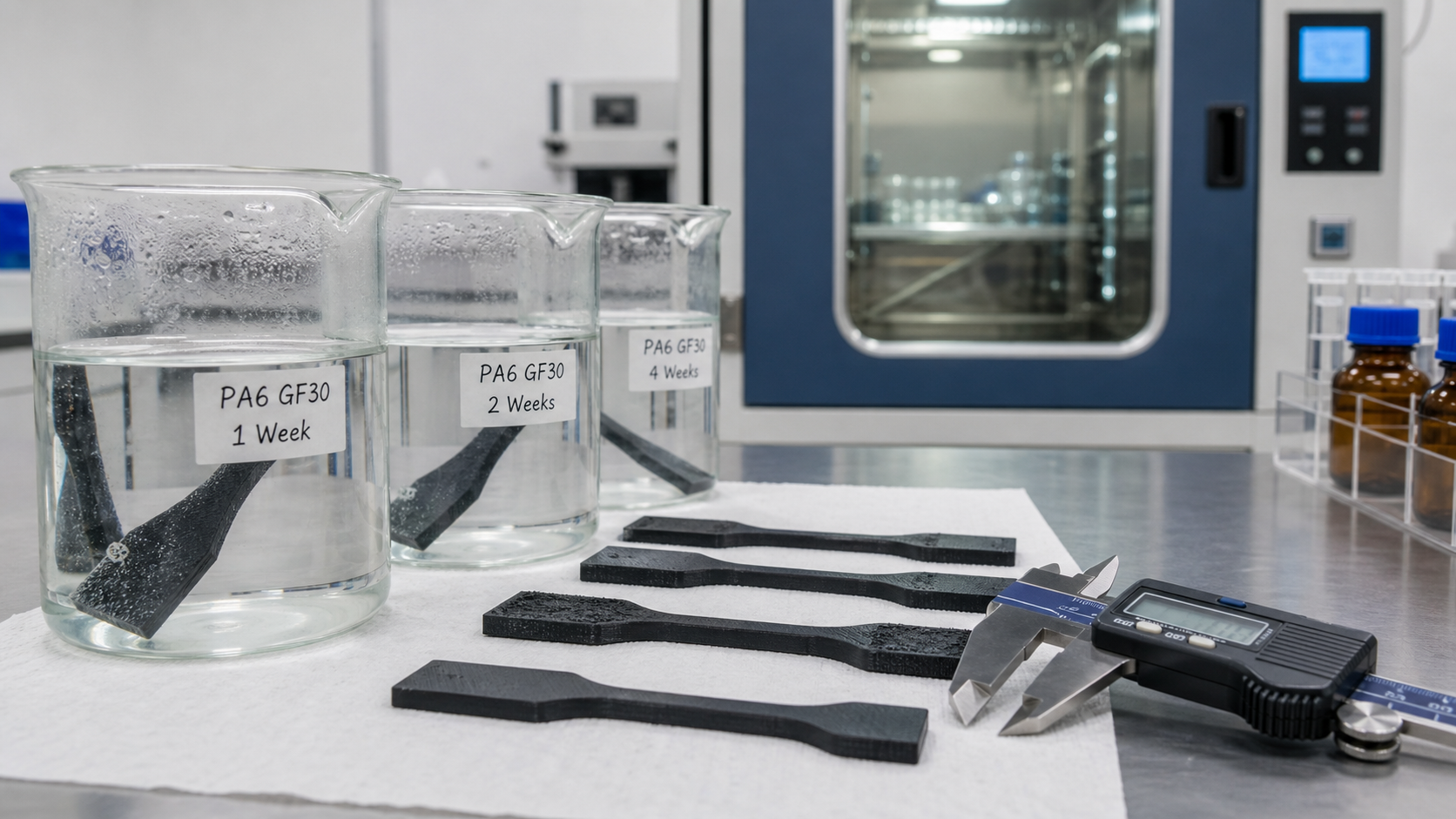
Moisture absorption changes nylon modulus, dimensions, and toughness, but much of that effect is reversible. Hydrolysis is different: it attacks the polymer chain itself and permanently reduces molecular weight.
Once hydrolysis progresses far enough, the part may embrittle, lose burst resistance, or fall out of tolerance even if the geometry originally passed inspection.
Which Nylon Grades Are Most Vulnerable
PA6 and PA66 can perform well in many dry mechanical applications, but both become higher-risk choices in sustained hot-water and steam service. Long-chain nylons usually hold dimensions better because of lower moisture uptake, though final suitability still depends on temperature and duty cycle.
Designers should also separate intermittent splash exposure from continuous immersion or sterilization duty, because those are very different material problems.
| Zustand | Typical Risk for PA6/PA66 | Typical Risk for PA11/PA12 | Recommended Next Step |
|---|---|---|---|
| Room-temperature humidity | Manageable | Unter | Condition and measure dimensions |
| Hot water around 80 C | Rising risk | Lower but not zero | Run immersion aging test |
| Repeated steam exposure | High risk | Case-specific | Compare with alternate resins |
| Autoclave-like cycles | Often unsuitable | Often case-specific | Validate with cyclic testing |
Where Hydrolysis Shows Up in Real Parts
Hydrolysis problems often appear in pump housings, hot-water fittings, appliance parts, fluid connectors, and sterilized assemblies. The failure mode may look like cracking, creep, or unexplained retention loss even though the root cause is polymer-chain degradation.
The earlier the design team defines temperature, dwell time, and fluid chemistry, the easier it is to avoid choosing the wrong nylon family.
Validation Questions Buyers Should Ask
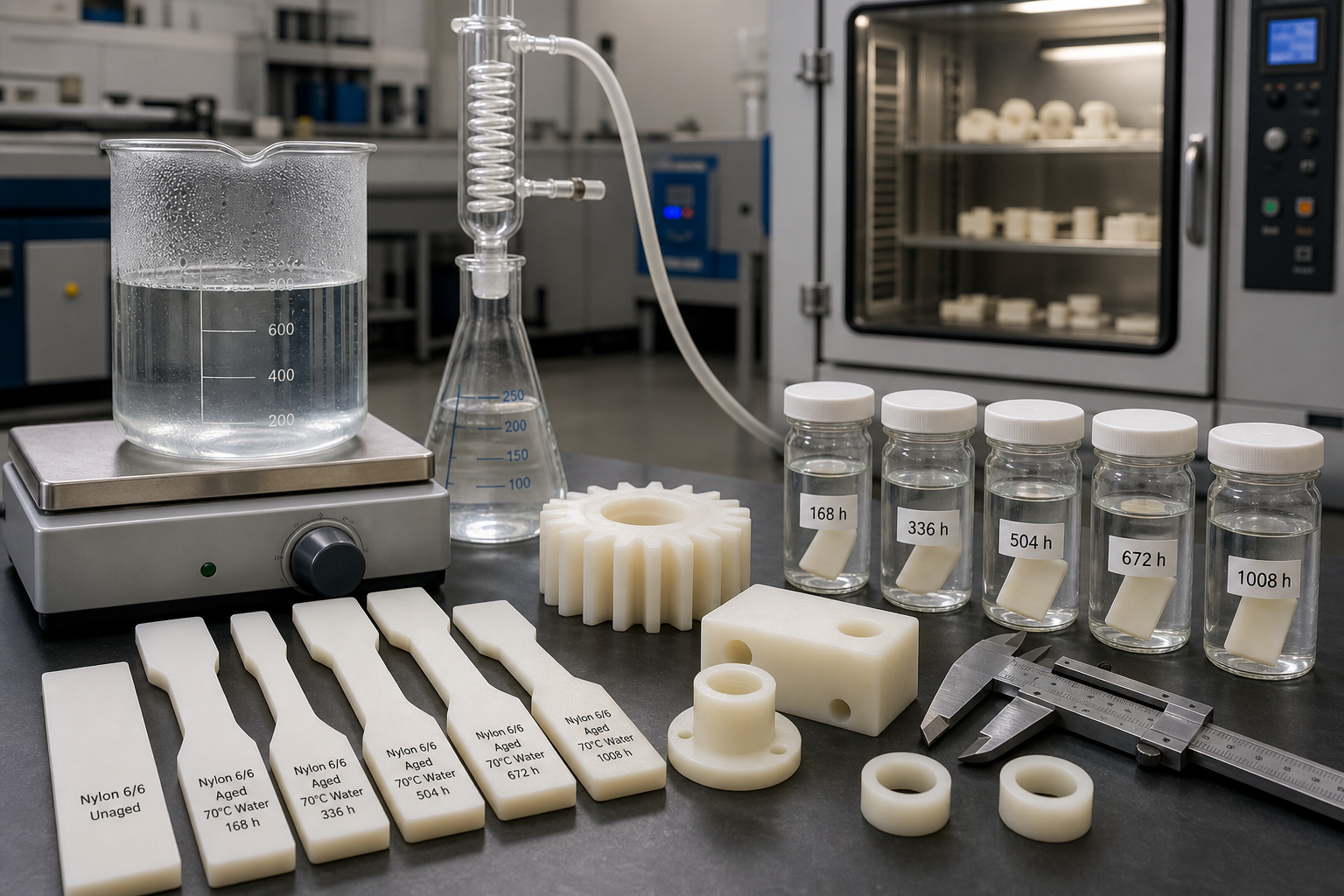
Ask how the supplier evaluated wet-heat performance and whether the published properties reflect dry, conditioned, or aged samples. If the part sees steam or high-temperature water, request retention data after aging instead of relying only on initial strength values.
- Was the material tested after immersion or cyclic exposure?
- At what temperature and for how long?
- What mechanical properties were re-measured after aging?
- Did the evaluation include assembled or stressed components?
Weiterführende Lektüre
- Leitfaden zur Feuchtigkeitsaufnahme von Nylon
- Leitfaden zur chemischen Beständigkeit von technischen Kunststoffen
- Long-Chain Nylons PA11 and PA12 Guide
FAQ
What causes hydrolysis in engineering plastics?
Hydrolysis happens when moisture, heat and susceptible polymer bonds combine over time. Nylon and other engineering plastics can lose performance if exposed to hot water or steam without grade-specific validation.
How can hydrolysis risk be reduced before production?
Select a suitable grade, dry and process the material correctly, avoid unnecessary molded-in stress, and validate the part after hot-water, steam or humidity aging.
Is surface appearance enough to judge hydrolysis damage?
No. A part can look acceptable while strength, elongation or layer adhesion has already declined. Mechanical testing and aging comparisons are more reliable.
Wenn Sie vom Material-Screening zur Produktion übergehen, sehen Sie sich unsere Nylon-Technikkunststoffe Seite mit den Notenoptionen, Dienstleistungen im Bereich Nylon-Spritzguss für Formteile, CNC-Bearbeitung von Nylon für bearbeitete Teile und 3D-Druck-Service für Nylon für Prototypen oder funktionsfähige Teile in kleinen Stückzahlen.

