Kosten im Spritzguss: Die Antwort aus der Technik
Die Kosten für den Spritzguss setzen sich aus den Kosten für das Werkzeug, die laufende Produktion, Nachbearbeitungsschritte, Qualitätsanforderungen und Logistik zusammen. Eine einfache Form kann nur wenige tausend Dollar kosten, während ein gehärtetes Mehrfachformwerkzeug mit Schiebern, Heißkanal, Strukturierung und Validierung Zehntausende von Dollar oder mehr kosten kann. Der richtige Vergleich lautet daher nicht: “Welches Formangebot ist am günstigsten?”, sondern: “Welches Angebot führt bei der erforderlichen Produktionsmenge zu den niedrigsten kontrollierten Kosten?”
Ein zuverlässiger Vergleich setzt voraus, dass jedes Angebot anhand derselben Formspezifikation, des gleichen Jahresvolumens, der gleichen Kunststoffsorte, der gleichen angenommenen Zykluszeit, des gleichen Prüfplans, der gleichen Verpackungsanforderungen und der gleichen Lieferbedingungen normiert wird. Weichen diese Vorgaben voneinander ab, sind die angebotenen Gesamtbeträge nicht direkt vergleichbar.
| Entscheidungsfrage | Kostentreiber noch zu bestätigen | Warum sich der Kurs ändert |
|---|---|---|
| Wie viele Teile werden pro Jahr benötigt? | Anzahl der Kavitäten, Formstahl, Automatisierung, Zykluszeit | Der jährliche Bedarf entscheidet darüber, ob ein kostengünstigeres Ein-Kavitäten-Werkzeug oder eine Produktionsform mit höherer Stückzahl die geringeren Gesamtkosten verursacht. |
| Welche Lebensdauer muss die Form erreichen? | Stahlsorte, Härte, austauschbare Einsätze, Verschleißschutz | Ein Prototypenwerkzeug und ein Werkzeug für eine Million Zyklen sollten nicht als gleichwertige Ausrüstung bewertet oder preislich gleichgestellt werden. |
| Welche Dimensionen sind entscheidend? | Bearbeitungsgenauigkeit, Formausrichtung, Prozessfähigkeit, Prüfung | Enge Toleranzen können die Kosten für Werkzeuge, Probenahme, Messtechnik und Prozesssteuerung erhöhen. |
| Was ist im Lieferumfang enthalten? | Entgraten, Einlegen von Einlegeteilen, Montage, Kennzeichnung, Prüfung, Verpackung | Ein niedriger Stückpreis für Formteile kann dazu führen, dass Arbeitsschritte, die zur Herstellung eines versandfertigen Endprodukts erforderlich sind, nicht berücksichtigt werden. |
Einleitung: Warum die Kosten für den Spritzguss so stark variieren
Angebote von zwei Fabriken $3,800 und $11,200 für dieselbe Form. In beiden Fällen heißt es: “P20-Stahl, zwei Kavitäten”. Wodurch lässt sich eine dreifache Preisspanne erklären? Die Antwort liegt selten in Unehrlichkeit – häufiger sind es Unterschiede darin, was das Angebot tatsächlich umfasst: Stahlzertifizierung, Härtung der Kavitäten, Rauhtiefe, Anzahl der Auswerferstifte, Kühlungslayout, Annahmen zur lebenslangen Garantie, Ersatz-Einsatzsätze und Nachbearbeitungsschritte, die der eine Anbieter im Paket anbietet, während der andere sie separat in Rechnung stellt.
In diesem Leitfaden werden die Kosten für den Spritzguss in folgende Bereiche unterteilt: Drei-Eimer-Modell, erläutert, welche Faktoren die einzelnen Kostenpositionen beeinflussen, stellt Ihnen 10 Fragen vor, mit denen Sie seriöse Anbieter sofort von Zeitverschwendern unterscheiden können, und liefert Referenzwerte, anhand derer Sie bereits vor den Verhandlungen erkennen können, ob ein Angebot wettbewerbsfähig ist.

Das Drei-Eimer-Kostenmodell
Jedes Spritzgussprojekt – ganz gleich, ob Sie 5.000 oder 500.000 Stück bestellen – lässt sich genau in drei Kostenkategorien unterteilen. Diese separat zu kalkulieren – und Pauschalangebote abzulehnen – ist die mit Abstand wirksamste Strategie zur Kostenkontrolle.
| Eimer | Was ist abgedeckt? | Typischer Anteil an den Gesamtkosten | Einmalig oder wiederkehrend |
|---|---|---|---|
| Gruppe 1: Formwerkzeuge | Formunterteil, Bearbeitung von Formnest und Kern, Heißkanal, Auswerfer, Kühlkanäle, Montage, Testlauf, Erstmusterprüfung | 60–85 % der Ausgaben im ersten Jahr (geringes Volumen) oder 10–25 % (hohes Volumen) | Einmalig (über die Projektlaufzeit abzuschreiben) |
| Gruppe 2: Stückpreis | Rohstoffe, Maschinenstundensatz, Arbeitskosten für Bedienpersonal, Strom, Gemeinkosten, Gewinnspanne | 15–40 % der Ausgaben im ersten Jahr (geringes Volumen) oder 75–90 % (hohes Volumen) | Wiederkehrend pro Aufnahme |
| Kategorie 3: Sekundäre Arbeitsgänge | Beschnitt/Entgraten, Ultraschallschweißen, Tampondruck, Heißprägen, Einlegen von Bauteilen, Montage, Verpackung | 5–25 % der Gesamtkosten des Bauteils (variiert stark je nach Komplexität des Bauteils) | Wiederkehrend pro Stück |
Wichtigste Erkenntnis: Ein Lieferant, der ein günstiges Angebot für die Werkzeugkosten unterbreitet, gleicht dies möglicherweise durch einen überhöhten Stückpreis aus. Fordern Sie in jedem Angebot stets an, dass die Kosten für „Bucket 1“ und „Bucket 2“ in separaten Zeilen aufgeführt werden. Wenn ein Lieferant sich weigert, diese aufzuschlüsseln, sollten Sie dies als Warnsignal betrachten.
Formenbau: Was bestimmt den Preis?
Auswahl der Stahlsorte
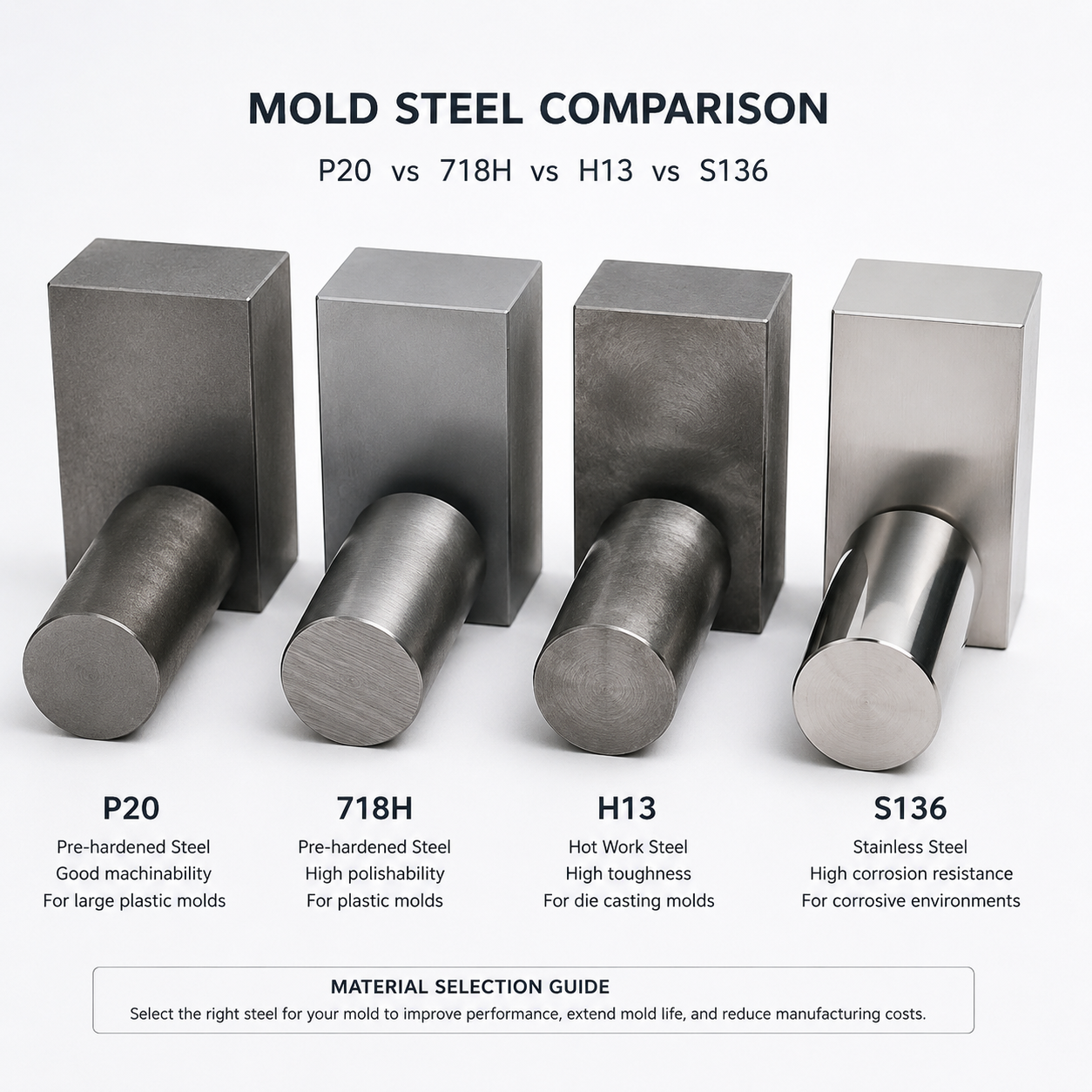
Der größte Einzelkostenfaktor bei jeder Form ist die für die Kavitäten- und Kerneinsätze gewählte Stahlsorte. Bei Prototypenformen (unter 10.000 Schuss) können Aluminium oder P20 ausreichen. Für Serienformen, die auf mehr als 500.000 Zyklen ausgelegt sind, ist gehärteter Stahl der Sorten H13 oder S136 unverzichtbar – und kostet im Voraus das 3- bis 5-Fache.
| Stahlsorte | Härte (HRC) | Nennlebensdauer (Schüsse) | Am besten für | Relativer Kostenindex |
|---|---|---|---|---|
| P20 (vorgehärtet) | 28–32 | 50,000–200,000 | Allzweck-Kunststoffe ohne Schleifwirkung (ABS, PP, PE) | 1,0x (Ausgangswert) |
| 718H (vorgehärtet, verbesserte Oberflächenqualität) | 33–38 | 100,000–300,000 | Hochglänzende Kosmetikteile, Linsen, transparente Teile | 1.3–1.6x |
| H13 (Warmumformung, durchgehärtet) | 48–52 | 500,000–1,000,000+ | Glasfaserverstärkte Kunststoffe, Anwendungen mit hoher Verschleißbeanspruchung, Großserienfertigung | 2.0–3.5x |
| S136 / 420 Edelstahl (gehärtet) | 48–54 | 300,000–800,000 | Medizinprodukte, für den Kontakt mit Lebensmitteln geeignete, korrosive Kunststoffe (PVC, POM) | 2.5–4.0x |
Faustregel: Bei Produktionsmengen unter 50.000 Stück ist P20 fast immer die richtige Wahl, es sei denn, Sie verarbeiten glasfaserverstärktes Nylon oder Hart-PVC. Lassen Sie sich von einem Lieferanten nicht dazu überreden, bei einem Auftrag über 20.000 Stück auf H13 umzusteigen – das macht sich einfach nicht bezahlt.
Kavitäten und die Wirtschaftlichkeit von Mehrfachkavitäten
Das Hinzufügen von Kavitäten ist ein klassischer Kompromiss: höhere Vorlaufkosten für die Werkzeugherstellung im Austausch für niedrigere Stückpreise. Der Zusammenhang ist nicht linear. Eine Form mit einer Kavität kostet X; eine Form mit zwei Kavitäten kostet etwa das 1,6- bis 1,8-Fache (nicht das Doppelte), da Formunterteil, Kühlkanal und Heißkanal gemeinsam genutzt werden. Ab acht Kavitäten steigt die Komplexität aufgrund von Herausforderungen hinsichtlich der Füllbalance und der gleichmäßigen Kühlung stark an.
| Karies | Faktor für Werkzeugkosten im Vergleich zu einer einzelnen Kavität | Auswirkungen auf die Zykluszeit | Am besten geeignet für (Jahresumsatz) |
|---|---|---|---|
| 1 | 1.0x | Ausgangswert | 1–10,000 |
| 2 | 1.6–1.8x | Die Stückzahl pro Zyklus verdoppelt sich; die Zykluszeit bleibt in etwa gleich | 10,000–50,000 |
| 4 | 2.5–3.2x | 4-fache Leistung; etwas längerer Zyklus zur Gewährleistung eines ausgewogenen Kühlungsverhältnisses | 50,000–250,000 |
| 8 | 4.0–5.5x | 8-fache Leistung; die Komplexität bei Kühlung und Gating verlängert den Takt um 10–15 % | 250,000–1,000,000 |
| 16+ | 6.0–9.0x | Erfordert eine fortgeschrittene Auswuchtung der Laufrollen; nicht alle Geometrien sind kompatibel | 1,000,000+ |
Komplexitätsfaktoren, die die Kosten für Formen in die Höhe treiben
Abgesehen von Stahl und Kavitation führen verschiedene Konstruktionsmerkmale zu einem Anstieg der Formkosten:
- Seitliche Bewegungen / Gleitbewegungen: Jede Hinterschneidung, die einen Seitenantrieb erfordert, erhöht die Werkzeugkosten um 800–3.000 US-Dollar (Preise in China). Bei einem Bauteil mit vier Seitenantrieben können sich die Kosten für die Formbasis verdoppeln.
- Hubkerne: Interne Hinterschneidungen, die durch Heber gelöst werden, verursachen in der Regel zusätzliche Kosten von 400 bis 1.200 Dollar pro Heber.
- Gewindekerne (Lösen): Drehbare Gewindekerne erfordern hydraulische oder zahnradgetriebene Mechanismen. Pro Gewindeelement fallen zusätzliche Kosten in Höhe von 2.000 bis 6.000 Dollar an.
- Enge Toleranzen: Toleranzen von ±0,05 mm bei beliebigen Abmessungen erfordern präzises Senk-EDM und eine genauere Ausrichtung der Form – dies erhöht die Bearbeitungskosten für die Kavitäten um 20–40 %.
- Hochglanz: Für die Spiegeloberflächen SPI A-1 bis A-3 werden Stahl der Sorten 718H oder S136 sowie 40–80 Stunden Handpolieren benötigt – je nach Oberfläche fallen zusätzliche Kosten in Höhe von 1.000–4.000 US-Dollar an.
- Textur (VDI/MT-Normen): Chemisches Ätzen oder Laserstrukturierung verursachen je nach Tiefe und Komplexität des Musters zusätzliche Kosten von 300 bis 2.000 Dollar pro Kavitätenseite.
- Konforme Kühlung: 3D-gedruckte Kühleinsätze, die sich den komplexen Konturen der Teile anpassen, können die Zykluszeit um 20–40 % verkürzen, erhöhen jedoch die Werkzeugkosten um 1.500–5.000 $. Bewerten Sie die Amortisationszeit anhand des Produktionsvolumens.

Aufschlüsselung des Stückpreises
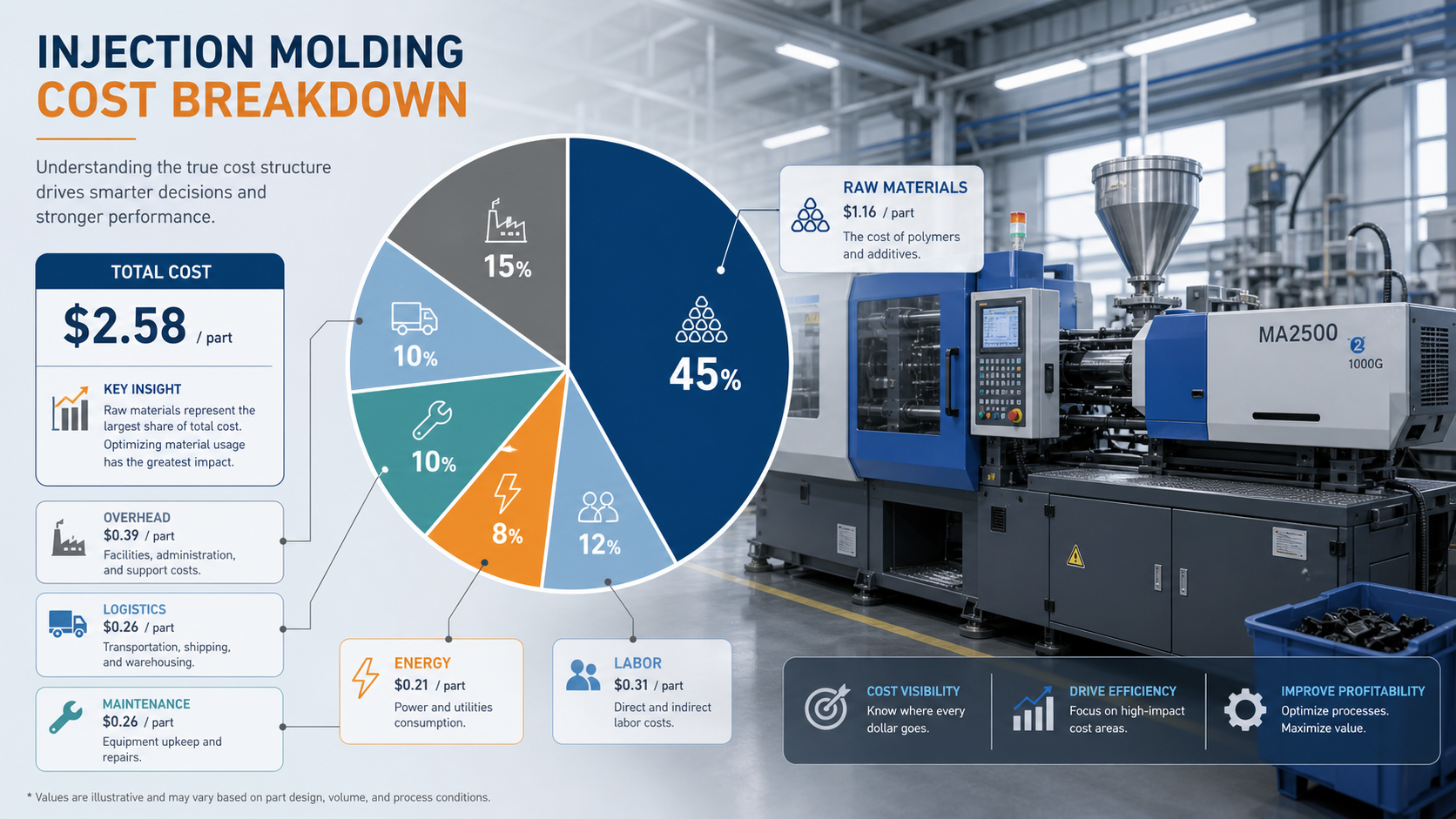
Sobald die Form fertiggestellt ist, setzen sich die wiederkehrenden Kosten pro Formteil aus drei Komponenten zusammen: Material, Maschinenzeit und Gemeinkosten.
Materialkosten (40–60 % des Stückpreises)
Der Materialpreis bestimmt maßgeblich den Stückpreis. Bei Standardkunststoffen (PP, PE, PS) liegen die Materialkosten bei 1,00–2,50 $/kg und machen 0,02–0,15 $ pro Teil aus. Bei technischen Kunststoffen (PA6 mit 30 % Glasfaser, PBT, POM) sind Kosten von 3,00–6,00 $/kg zu erwarten. Bei Hochtemperatur- oder Spezialkunststoffen (PEEK, PPS, LCP) können die Materialkosten allein 40–80 $/kg erreichen.
Eine Praxis von Lieferanten, die man im Auge behalten sollte: Viele chinesische Lieferanten schlagen 8–15 % auf die Rohstoffkosten als Aufschlag für die “Materialabwicklung” auf. Manche geben den Materialpreis zum vollen Listenpreis an, während sie selbst zu ermäßigten Mengenrabatten einkaufen und die Differenz in die eigene Tasche stecken. Fragen Sie nach, ob der Materialpreis zum Selbstkostenpreis oder nach dem Cost-Plus-Prinzip angegeben wird, und verlangen Sie in jeder Angebotszeile die Angabe der Kunststoffmarke und -sorte.
Maschinensatz (15–50 $/Std. in China, 60–180 $/Std. in westlichen Märkten)
Der Stundensatz pro Maschine umfasst die Abschreibung der Presse, Strom, Wasser, das Gehalt des Bedieners sowie die grundlegenden Gemeinkosten. Die Sätze variieren je nach Maschinenleistung:
| Spannkraft (Tonnen) | Typischer Stundensatz – China (USD/Std.) | Typischer Stundensatz – Nordamerika/Europa (USD/Std.) |
|---|---|---|
| 80–120T | $4–10 | $35–55 |
| 160–250T | $8–18 | $45–75 |
| 300–500T | $15–30 | $60–120 |
| 650–1,200T | $25–50 | $90–180 |
Machine rates below $4/hr in China should trigger skepticism — at that level, the supplier is either losing money on the press or compensating through inflated material pricing.
Cycle Time and Its Leverage
A part that cycles in 18 seconds costs roughly half as much per unit as the same part cycling in 36 seconds (all else equal). Cycle time is the product of injection time, cooling time (typically 50–70% of total cycle), mold opening/closing, and part ejection. Optimizing cooling layout in the mold design phase — running larger water lines, using bubblers or baffles for deep cores, or specifying conformal cooling — can reduce cycle time by 20–40% and deliver a 6-month payback through reduced part unit prices.
Ten Questions to Ask Before You Accept Any Quote
These questions are designed to expose gaps in the quote — things the supplier left out intentionally or simply did not think of. A supplier that answers all ten comfortably is worth a deeper conversation. One that dodges three or more should be dropped immediately.
- “Is the steel grade certified? Can you provide the mill certificate with the mold?” Many suppliers say “P20” and deliver a lower-grade equivalent (e.g., 2738 or 2311 with reduced hardness). Require the mill certificate.
- “Does the tooling price include a mold-flow analysis, or is that billed separately?” Mold-flow analysis (Autodesk Moldflow or Moldex3D) typically costs $400–1,200 and is often excluded. Without it, you risk gate placement and warpage problems discovered only at trial.
- “How many spare ejector pins, spare core pins, and spare heater bands are included?” Standard practice is one spare ejector pin of each size, one spare core pin per cavity, and one spare heater band per zone. If zero spares are included, add $200–600 to initial budget.
- “What texture depth and standard are included, and is there a per-side charge?” Texture (e.g., VDI 24, MT-11010) costs $200–800 per side. Confirm it is included — not billed separately after mold acceptance.
- “Is PPAP (Production Part Approval Process) included, and to what level — Level 1, 2, or 3?” A full PPAP Level 3 submission (dimensional report, material cert, capability study, control plan) costs $800–2,500 and is rarely included in the base tooling price.
- “Is the mold warranty for lifetime or a fixed number of shots? What is covered — just the cavity/core, or also the hot-runner system and ejector mechanism?” Most suppliers warrant against manufacturing defects for 100,000–200,000 shots, but many exclude hot-runner components (which carry their own manufacturer warranty). Get the exclusion list in writing.
- “What is the maintenance interval, and do you provide a recommended spare-parts list with lead times?” Every mold needs periodic preventative maintenance — cleaning, lubrication, sharpening. A supplier without a documented PM plan has not thought about your mold beyond delivery.
- “Does the part unit price include deflashing, de-gating, and packaging? If not, what are the secondary operation adders?” Secondary operations are the most commonly omitted costs in injection molding quotes. A part that arrives still attached to the runner is not a finished part.
- “What is the payment structure — and what milestone gates release each payment?” Standard terms are 30–50% deposit with mold design sign-off, 30–40% at first trial (T1), and 15–20% at PPAP approval or shipment. Avoid 100% upfront, and ensure the final 10–15% is held until at least T1 samples are approved.
- “Can you provide three references for projects with similar part size, material, and volume within the last 12 months?” If a supplier hesitates here, they may not have relevant experience. A reference check takes 15 minutes and can save tens of thousands of dollars in failed tooling.
Quick Reference: Cost Ranges by Part Complexity
The table below provides rough order-of-magnitude ranges for mold tooling and unit price, based on part complexity for parts weighing 20–200 grams in commodity-grade P20 steel, produced in China. Add 25–50% for Western European or North American tool shops. Add 30–80% for H13 or S136 steel.
| Part Complexity | Example Parts | Mold Tooling (Single Cavity, P20, China) | Unit Price Range (Material + Machine) | Typische Lieferzeit |
|---|---|---|---|---|
| Simple (no side actions, open-close only) | Flat caps, spacers, simple bushings, nameplates | $1,800–4,500 | $0.08–0.35 | 4–6 Wochen |
| Mäßig (1–2 side actions, basic ribs) | Enclosures, brackets, housings, connectors | $4,500–12,000 | $0.25–0.85 | 6–9 weeks |
| Complex (3+ side actions, threads, tight tolerances) | Automotive interior trim, medical device housings, multi-port manifolds | $12,000–35,000 | $0.60–2.50 | 10–16 weeks |
| Hochpräzise (lens-grade polish, <0.02mm tol., cleanroom) | Optical lenses, microfluidic chips, implantable device components | $30,000–120,000+ | $1.50–15.00+ | 14–24 weeks |
Anmerkung: These ranges assume a single-cavity mold in P20 with no hot runner, standard SPI B-2 finish, and no secondary operations included. Every additional feature — slides, texture, hot runner, conformal cooling — pushes the number toward the high end of the band or above it.
Hidden Costs That Ambush Budgets
Most first-time buyers budget for the three buckets and stop. The items below are the most common budget killers — none are unreasonable to pay, but all should be confirmed as included or excluded before you sign a purchase order.
| Hidden Cost Item | Typical Range (China) | Why It Gets Missed |
|---|---|---|
| Design-for-Manufacturing (DFM) revisions | $300–1,500 | Some shops charge for DFM reports; others bundle them. Confirm in writing. |
| Mold-flow analysis | $400–1,200 | Often excluded from tooling quotes; added as an engineering line item. |
| Texture / grain | $300–2,000 per side | Quoted mold may assume as-machined finish or SPI B-2 only. |
| PPAP / dimensional report | $800–2,500 | Level 3 PPAP requires CMM measurement, capability studies, and control plans. |
| Packaging design and custom packaging | $0.02–0.15 per part | Bulk-pack in polybags is typically included; custom retail packaging is not. |
| Mold modifications after T1 trial | $500–3,000 per change | Most quotes cover minor adjustments (gate size, vent depths). Dimensional changes are extra. |
| Mold maintenance (preventative) | $200–800 per service interval | Often ignored until flash or short shots appear — by which point repair cost is higher. |
| Freight and import duties | $500–2,500 (sea freight) or $1,500–5,000 (air freight) | Molds weigh 80–800 kg. Sea freight ex-China to US runs $200–600/cbm plus duties. |
How to Normalize Injection Molding Quotes
Before comparing prices, place every supplier response into one quotation matrix. Blank cells are not minor administrative details; they are unpriced risk. Require each supplier to state assumptions rather than allowing “standard tooling” or “standard inspection” to stand without a definition.
| Quotation Line | Minimum Information Required | Risk If It Is Missing |
|---|---|---|
| Mold construction | Mold base supplier, cavity/core steel, hardness, heat treatment, cavity count, runner type, slides/lifters, cooling layout | Suppliers may quote materially different tool lives under the same general description. |
| Mold ownership and transfer | Legal owner, storage period, maintenance responsibility, transfer documentation, export crating and transfer charge | The buyer may discover that the mold cannot be moved or that drawings and process records are unavailable. |
| Trial and approval | Number of T0/T1 trials, sample quantity, dimensional report, material certificates, correction allowance | Sampling, inspection, and routine mold corrections may appear later as additional invoices. |
| Part price basis | Resin manufacturer and grade, color, regrind allowance, part and runner weight, cycle time, cavities, machine size, scrap assumption | The price cannot be recalculated when resin, cycle time, or production volume changes. |
| Quality level | Critical dimensions, sampling plan, CMM or gauge requirements, capability targets, FAI/PPAP documentation | Suppliers may quote basic visual inspection against a requirement that actually needs documented process capability. |
| Commercial basis | Currency, Incoterm, payment schedule, validity period, tax, freight, duty, packaging, warranty | A factory price can appear lower while producing a higher landed and qualified cost. |
Use Total Landed Program Cost, Not Piece Price Alone
A practical sourcing model is:
Total landed program cost = tooling and NRE + (approved quantity x finished-part unit price) + validation + packaging + freight and duty + expected maintenance and engineering changes.
For example, Supplier A may quote a $9,000 mold and a $1.10 part, while Supplier B quotes a $14,000 mold and a $0.78 part. At 10,000 parts, Supplier A appears lower before qualification and logistics. At 100,000 parts, the $0.32 unit-price difference is worth $32,000 and can outweigh the higher tooling investment. The calculation must also check whether both suppliers assumed the same resin, cavity count, cycle time, scrap rate, quality documentation, and delivery term.
Separate Price Uncertainty from Technical Risk
Ask the supplier to mark each quotation line as fixed, estimated, or dependent on DFM/T1 results. Mold price can usually become fixed after DFM approval. Part price may remain conditional on verified cycle time, runner weight, final resin pricing, and packaging. This distinction lets procurement compare commercial exposure without forcing engineering assumptions into a falsely precise number.
RFQ Checklist for an Accurate Injection Molding Cost
The quality of the quotation depends on the quality of the RFQ package. Send the same controlled package to every supplier and identify unresolved assumptions explicitly.
- 3D CAD: STEP or Parasolid file at the current revision.
- 2D drawing: critical dimensions, tolerances, datum scheme, threads, inserts, surface finish, texture, and cosmetic zones.
- Demand profile: prototype quantity, first order, annual volume, peak monthly demand, and expected program life.
- Material specification: polymer family plus exact manufacturer/grade where performance or compliance depends on it; include color, filler, flame rating, UV package, and regrind restrictions.
- Tooling requirement: target tool life, preferred cavity count, hot- or cold-runner preference, mold ownership, storage, maintenance, and transfer expectations.
- Qualitätsplan: FAI, dimensional report, material certificate, capability study, PPAP level, gauge requirements, and traceability.
- Delivered-part scope: degating, insert installation, assembly, printing, welding, cleaning, individual packaging, labeling, and export packing.
- Commercial basis: delivery location, Incoterm, desired lead time, quotation currency, payment terms, and whether freight and duty must be included.
If the design is not production-ready, request a documented DFM review before locking the tool price. Gate location, draft, wall transitions, undercuts, tolerance allocation, and expected shrinkage can change both the mold concept and the recurring part cost. Use the Leitfaden zur Torplanung, Leitfaden zur Auswahl von Werkzeugstahl, und Leitfaden zur Toleranzkumulierung to define those decisions before supplier comparison.
When the Lowest Quote Is the Right Quote
The lowest quote can be the best choice when the tool specification is equivalent, the supplier has demonstrated the required process and inspection capability, exclusions are transparent, and the total landed cost remains lowest at the expected volume. A higher quotation is not automatically better. The objective is evidence-based equivalence, followed by commercial comparison.
When to Reject a Low Quote
Reject or clarify a quotation when the supplier cannot identify mold steel and hardness, does not state cavities and cycle-time assumptions, substitutes an unspecified resin, excludes dimensional approval, cannot explain mold ownership, or offers a piece price without runner weight and secondary-operation scope. Those omissions transfer cost and schedule risk to the buyer rather than eliminating it.
For a manufacturing review, send the CAD model, drawing, resin requirement, annual volume, and inspection level through the form below. Nylon Plastic can compare tooling route, expected mold life, unit-cost drivers, and prototype-to-production options before quotation.
Häufig gestellte Fragen
Wie viel kostet eine Form für ein kleines Kunststoffteil (unter 30 Gramm)?
For a simple part (no side actions, open-close only, P20 steel, single cavity, no hot runner) manufactured in China, expect $1,800–4,500. For the same part with a two-cavity configuration, expect $3,000–7,500. Add 25–50% for Western tool shops. If the part requires side actions, tight tolerances (under ±0.05 mm), or a high-gloss SPI A-2 finish, move the range up to $5,000–15,000. The single largest variable at this size range is whether a hot-runner system is required — a single-drop hot runner alone adds $1,200–3,500 to tooling cost.
Wie kann ich überprüfen, ob der Lieferant die im Angebot angegebene Stahlsorte verwendet hat?
Three methods, in order of reliability: (1) Require the mill certificate — a traceable document from the steel mill (e.g., Bohler, ASSAB, Daido) showing heat number, chemical composition, and hardness. Match the heat number to the physical stamp on the mold base. (2) Request a portable hardness test during a video inspection — a calibrated Leeb hardness tester applied to the cavity surface takes 30 seconds and gives an immediate reading. P20 should read 28–32 HRC; H13 should read 48–52 HRC. (3) For high-value molds ($30,000+), commission a third-party inspection through a firm like SGS, Bureau Veritas, or TUV, which can perform handheld XRF (X-ray fluorescence) analysis to verify alloy composition against the mill certificate. This costs $300–800 and is standard practice in the automotive and medical sectors.
Wann lohnt sich ein Heißkanalsystem im Vergleich zu einem Kaltkanalsystem?
The break-even calculation depends on material waste and cycle time. A cold runner system leaves a solidified sprue and runner that must be reground or discarded — for a multi-cavity mold producing small parts, the runner can equal 30–60% of the shot weight. Rule of thumb: if the runner-to-part weight ratio exceeds 25%, a hot runner pays for itself within 50,000–100,000 shots through material savings alone. Additionally, hot runners reduce cycle time by 5–15% (no runner cooling time) and eliminate regrind handling. For high-value engineering resins (PA66 GF30 at $4–6/kg, or PEEK at $50+/kg), the payback is even faster — sometimes under 20,000 shots. For commodity PP at $1.50/kg, the math is less favorable and a cold runner with regrind reuse often makes more sense below 100,000 units.
Sollte ich die Mold-Flow-Analyse separat bezahlen, oder sollte sie im Preis inbegriffen sein?
It depends on part complexity. For simple parts (uniform wall thickness, single gate location, no flow-length concerns), a mold-flow analysis provides limited additional value — a competent toolmaker can predict fill behavior from experience. However, for any part with thin walls (under 1.2 mm), long flow-length-to-thickness ratios (over 150:1), multiple gate locations, or glass-filled resins, a mold-flow analysis is worth its cost. Without one, you risk weld-line placement in structurally critical areas, air traps causing burn marks, and warpage from differential shrinkage. The $400–1,200 analysis cost is a fraction of what it costs to re-cut a gate or add a vent after T1. If the supplier pushes back on including it, offer to pay for it yourself and own the report — this way, the data serves your project even if you change suppliers later.
Weiterführende Lektüre
- Low-Volume Injection Molding for Small-Batch Production
- How to Reduce Injection Molding Part Cost
- How to Reduce Injection Molding Lead Time
Planning note: Price and mold-life ranges on this page are comparison benchmarks, not a fixed Nylon Plastic quotation. For drawing-specific DFM, tooling and part-price review, use our plastic injection molding services and submit the drawing, material and volume.